Dr. Cogan's Research Page

N. G. Cogan - Research
Some of this research was supported by a an NSF Award #0612467

Overview:


Publications :


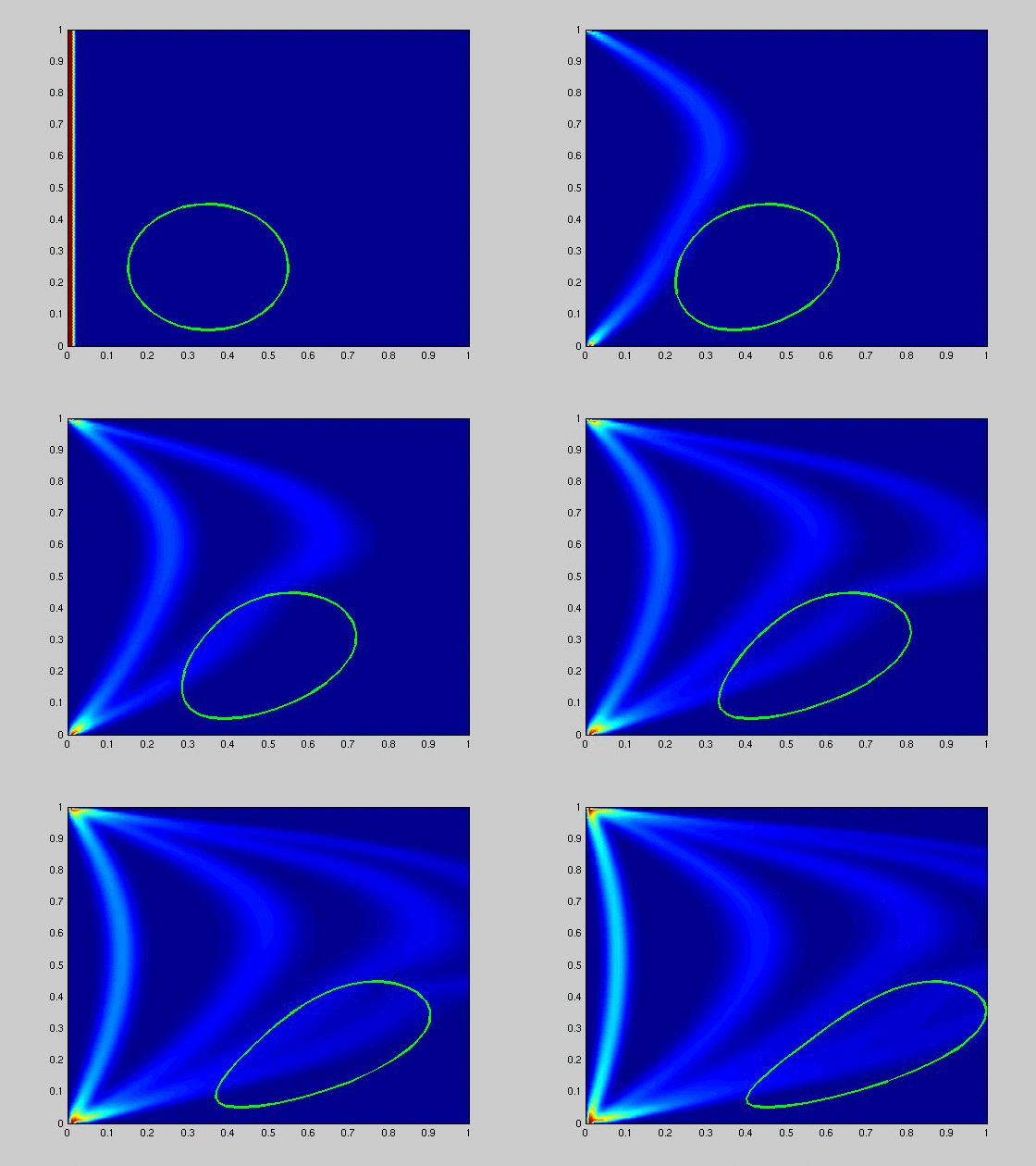
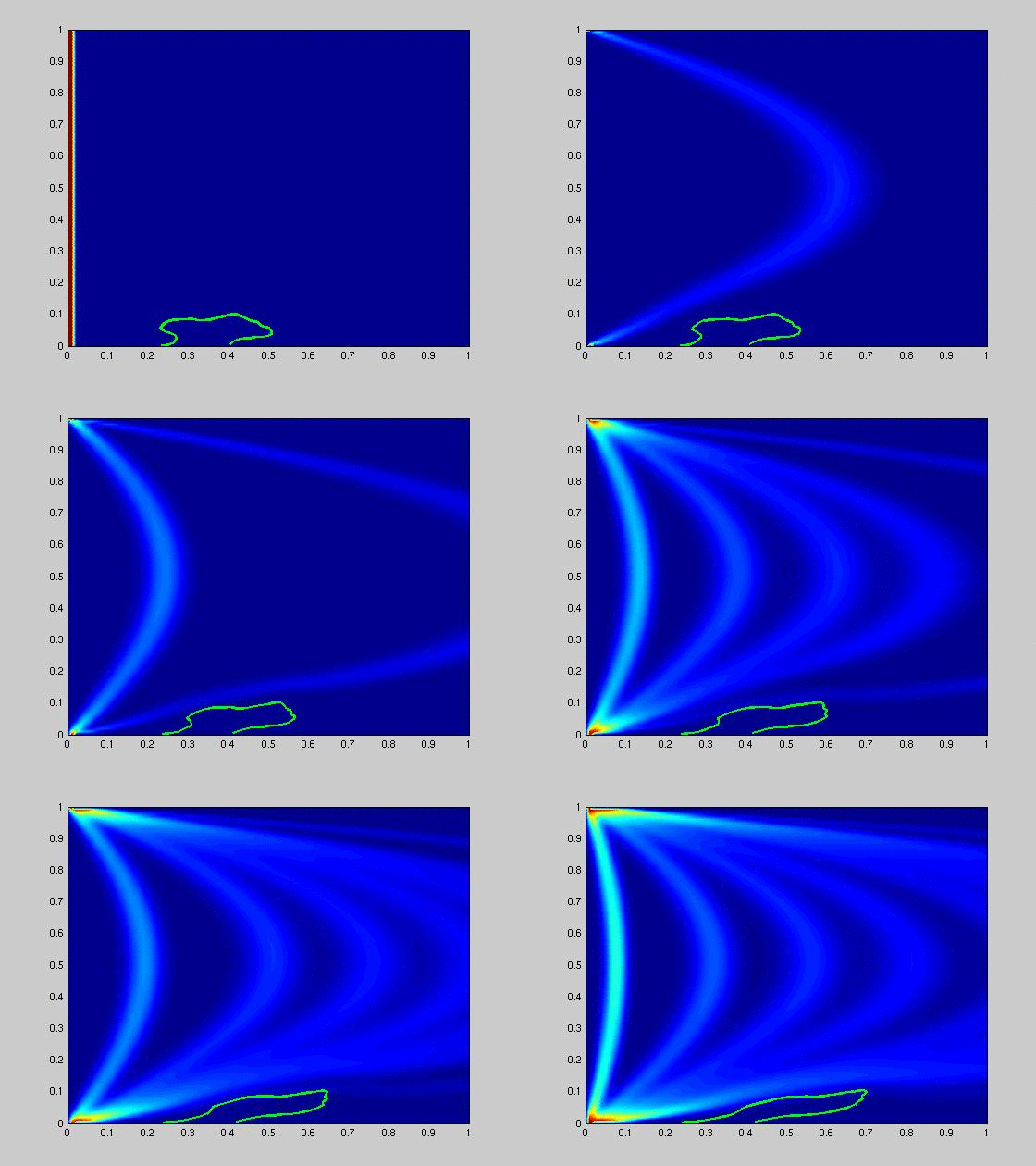
16.) N.G. Cogan, Donald A. French, Sookkyung Lim, Mauricio Osorio, M. Kupferle, Distributions of Bacteria and Biofilms in Urban Pipes, In Progress.

15.) N. G. Cogan, Modeling Biofilm Disinfection, Growth and Motion in Flowing Systems, In Progress

14.) N.G. Cogan and Charles W. Wolgemuth, Instability of a two-dimensional bacterial veil in a three-dimensional fluid, In Progress.

13.) Patrick De Leenheer and N.G. Cogan, Failure of antibiotic treatment in microbial populations, Submitted

12.) N. G. Cogan and Claudia Avalos, Run and Reverse Strategies in structured flows, Submitted

11.) N. G. Cogan and Shankar Chellam, Regularized Stokeslets Solution for 2-D Flow in Dead-end Microfiltration: Application to Bacterial Deposition and Fouling, Journal of Membrane Science 318(1-2) pp: 379-386 (2008)

10.) Tianyu Zhang, N. G. Cogan and Qi Wang, Field-Phase Models for Biofilms. II. 2-D Numerical Simulations of Biofilm-Flow Interaction, Communications in Computational Physics, 4(1) pp: 72-101 (2008)

9.) Tianyu Zhang, N. G. Cogan and Qi Wang, Phase-Field Models for Biofilm. I. Theory and 1-D Simulations, In Press SIAM J. Appl. Math

8.) N. G. Cogan, A Two-Fluid Model of Biofilm Disinfection , Bulletin of Mathematical Biology, 70(3) pp. 800-819 (2008)

7.) Nicholas G. Cogan, Hybrid Numerical Treatment of Two Fluid Problems with Passive Interfaces , COMM. APP. MATH. AND COMP. SCI. Vol 2., No. 1, pp. 117-133 2007

6.) N. G. Cogan Incorporating Toxin Hypothesis into a Mathematical Model of Persister Formation and Dynamics , Journal of Theoretical Biology 248 (2007): 340-349

5.) N.G. Cogan, Effects of Persister Formation on Bacterial Response to Dosing , Journal of Theoretical Biology 238(3): 694-703 (2006)

4.) N. G. Cogan and C.W. Wolgemuth, Pattern Formation in Bacterial Veils, Biophysical Journal 88, 2525-2529 (2005)

3.) N.G. Cogan, Ricardo Cortez and Lisa J. Fauci, Modeling Physiological Resistence in Bacterial Biofilms, Bulletin of Mathematical Biology 67 (4): 831-853 (2005)

2.) N.G. Cogan and James P. Keener, Channel Formation in Gels , SIAM J. Appl. Math., Vol. 65, N0. 6, pp. 1839-1854.

1.) N.G. Cogan and James P. Keener, The Role of the Biofilm Matrix in Structural Development Mathematical Medicine and Biology 21(2),147-166 (2004)


Biofilm Simulations (quicktime):


Fingering instability: Production of polymer induces gradients in osmotic pressure. Expansion of the biofilm gel leads to a surface instability. Mushroom
Disinfection: Dynamic disinfection zones with no external flow. The disifectant reacts with a component of the biofilm, destroying both the disinfectant and the nuetralizer. No Flow
Fluid Visualization: Movie showing advective transport of a passive marker dye. There is no explicit diffusion, although the numerical method is diffusive. Fluid Visual
Disinfection: Disinfection simulation indicating that physiological resistance cannot be the only resistance mechanism employed by biofilms. Disinfection
Moving Cluster with advection of a dye. (NOTE: this is an animated GIF and takes a loooong time to load: Cluster
Moving Circle-centered: Simulation of a blob of viscous fluid immeresed in water with a parabolic background flow. Circle - centered
Moving Circle-off center: Simulation of a blob of viscous fluid immeresed in water with a parabolic background flow. Circle - off center
One Cluster: One cluster in a parabolic background flow Cluster
Two Clusters:Two initially identical clusters in parabolic background flow Two Clusters
One Cluster: Growth and response to fluid Growing Biofilm
Two Clusters: Growth and response to fluid Growing Biofilm