| Course page: |
ON CAMPUS: http://www.math.fsu.edu/~mesterto/PDEII.html (this
page)
OFF CAMPUS:
http://www.math.fsu.edu.proxy.lib.fsu.edu/~mesterto/PDEII.html (with your
FSUID username and password) |
| Professor: | Dr Mesterton-Gibbons, or Dr M-G for short |
| Office: |
202B Love |
| Office hours: |
Please click here. Office hours are
subject to change during the semester at 24 hours notice, but
current times are always posted online. Note that office hours are
primarily for personal matters that cannot be addressed in class
(as opposed to tutorial help, for which see under How to study below) |
| Phone: |
(850 64)4 2580 |
| Main website: |
Professor
M-G's Home Page Email:
|
| Class meets: | in 201
Love on Mondays, Wednesdays and Fridays at
12:20—1:10 p.m. |
| Format: | The course will be based on
my lecture notes with problems (which I will email to
you after class, and which you can also download from
here)
|
| Text: | There is no required text.
However, if you already own a text on partial
differential equations—e.g., because you used one
for MAP 4341—then I recommend keeping it until the
semester has ended, because it will be useful as a
reference |
| Credit: |
3 semester hours |
| Prerequisites: | | (i) | MAP 4341; or
Professor M-G's consent and |
| (ii) | self-motivation and
industriousness |
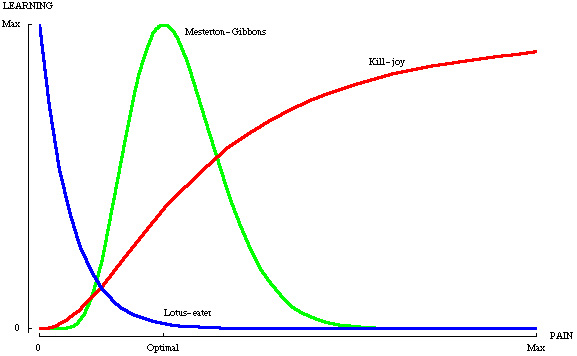
| My philosophy of learning is perhaps best
expressed by the green curve in the diagram below: |
|
| |
ALTERNATIVE THEORIES OF LEARNING VERSUS
PAIN
 |
For further details, please click here.
|
| Communication: |
I will send email to your FSU email account on a regular
basis. It is your responsibility to check it regularly (or arrange to
have my messages forwarded, if you prefer to read your email
elsewhere) |
| Your name: |
 |
| I don't
know who you are (for the most part), but because everything
works so much better when I do, I would like to learn your name
as soon as possible. So, please take a sheet of card stock (or
even paper), fold it in half, write your name in large letters
on one side and stand it up on your desk so that I can see it.
(Write what you want me to call you: if you're a William who
likes to be called Dubya or a Margaret Jane who likes to be
called Dee Dee, write Dubya or Dee Dee, not William or Margaret
Jane.) Please bring your nameplate to every class until I have
finally learnt your name (which will take significantly longer
than it used to take when I started out) |
|
| Grades: | Will be based on four written assignments (20% apiece) and a final exam (20%), for
all of which you must use blue or black ink. If you make a
mistake when writing in ink, then just cross it out and make a
correction—which is far more efficient temporally than erasing
pencilling, and may even earn you otherwise unavailable partial credit
(if it turns out that you were right before you changed your mind).
Note that quality of presentation is extremely important, and so there
will be penalties (commensurate with degree of infraction) for badly
presented work. It is not enough merely to produce an answer. The
method by which you obtain it must be sound and clearly (implying
legibly) demonstrated: Show all necessary steps in your method,
with enough comments or diagrams to convince that you thoroughly
understand. On the other hand, don't turn in acres and acres of
verbiage: although it is generally better to err on the side of saying
too much than on the side of saying too little, saying far too much is
usually an indication that you don't really know what you are talking
about and are trying to
hide it with words.
Precise cut-off points for A, B and C will be
determined by the distribution of grades at the end of the semester,
but are likely be in the vicinity of 90%, 80% and 70%, respectively. In
borderline cases, a smaller number of completely correct solutions will
carry more weight than a proportionate number of fragmentary answers;
later scores will carry more weight than earlier scores; and a record
of active participation in class will carry more weight than a record
of passive attendance. Plus or minus grades may be assigned in a
manner consistent with standard University practice.
Please note that partial credit will be awarded
only when part of a solution is completely correct—not when all of
a solution is partially correct, whatever that means, if anything. A
score for a question worth 10 points should be interpreted as follows:
| 10 |
Practically perfect |
9 |
Still very good, but
lacking—or wrong about—a significant detail |
| 8 |
Still good, but lacking—or
wrong about—significant details |
| 7 |
Minimally satisfactory. You
have—just—managed to demonstrate that you basically
understand and are at least capable of getting all details correct
(although it clearly did not happen this time) |
| 6 |
A grade that will not be given |
| 5 |
Half right in some appropriate sense
(e.g., there were two parts, each worth 5 points, and your first part
was practically perfect) |
| 1-4 |
Not even half right and showing
little understanding, but some degree of positive effort |
| 0 |
Zero effort, or submitted in pencil |
Also note that a grade of I will not be given to avoid a grade of F or to
give additional study time. Failure to process a course drop will result in
a course grade of F |
| Attendance policy: | You are expected to attend class
regularly, and bear the full responsibility for learning anything
covered during any class that you miss. On the other hand, it would be
extremely anti-social to attend class if you either have, or are coming
down with, a contagious disease. Please keep me apprised (by email) of
any illness or other emergency, so that I can make any necessary
adjustments (and please make friends within the class as soon as
possible if you haven't done so already, so that there is someone you
can call upon to borrow notes if the need should ever arise) |
| Etiquette: |
You are firmly bound by Florida State University's Academic Honor Code. Briefly, you have the
responsibility to uphold the highest standards of academic integrity in
your own work, to refuse to tolerate violations of academic integrity
in the University community, and to foster a high sense of integrity
and social responsibility on the part of the University community. Even
more briefly, you must neither cheat nor enable others to cheat. The
penalties for violations can be severe. Please carefully read the
section in the FSU Student Handbook on the Honor Code and official
procedures for dealing with students who violate it. Although you may
discuss assignments with others in general terms, the solutions
you present must be your very own work ("in general terms" means that
discussion is oral and nothing is copied down). If you are in any doubt
at all as to what constitutes acceptable behavior in this regard, you
should ask me for clarification.
You are also bound by the ordinary rules and
customs of polite behavior that prevail in a civilized society. (In
particular, you are not allowed to use a cell phone or otherwise have
private conversations with others during class; and you are not allowed
to create disturbances through arriving late or leaving early.) |
| Final: | Thursday, April 28, 3:00—5:00 p.m. in 201 LOV |
| How to study: |
It is important that you keep up with the course from the very
beginning, always attempting as many as possible (preferably all) of
any homework problems. If you get stuck, then send me a question by
email. As soon as I possibly can, which might be as soon as within half
an hour, but might also be a day or two later (I have a life, too, you
know), I will reply—not to you, but rather to the class alias
(after carefully concealing your identity, just in case you are
inexplicably bashful about being perceived as smart enough to ask a
question).
Note, however, the following. First, you must
identify yourself (i.e., you remain anonymous to the other students in
the class, but not to me) in the body of your message (because
your username does not identify you to me, and I don't reply to
anonymous email). Second, you should be as specific as possible in
describing your difficulty: the more precisely you identify how you got
stuck, the more helpful my reply is likely to be |
| Disabilities: |
If you have a disability requiring academic accommodations, then
not only should you register with the Student Disability Resource
Center (SDRC), but
also you should bring me written confirmation from SDRC during the
first week of class |
ALL SYLLABI ARE REQUIRED TO INCLUDE THE FOLLOWING STATEMENTS
University Attendance Policy:
Excused absences include documented illness, deaths in the family and other
documented crises, call to active military duty or jury duty, religious
holy days, and official University activities. These absences will be
accommodated in a way that does not arbitrarily penalize students who have
a valid excuse. Consideration will also be given to students whose
dependent children experience serious illness.
Academic Honor Policy:
The Florida State University Academic Honor Policy outlines the
University's expectations for the integrity of students' academic work, the
procedures for resolving alleged violations of those expectations, and the
rights and responsibilities of students and faculty members throughout the
process. Students are responsible for reading the Academic Honor Policy and
for living up to their pledge to ". . . be honest and truthful and . . .
[to] strive for personal and institutional integrity at Florida State
University." (Florida State University Academic Honor Policy, found at http://fda.fsu.edu/Academics/Academic-Honor-Policy.)
Americans With Disabilities Act:
Students with disabilities needing academic accommodation should:
(1) register with and provide documentation to the Student Disability
Resource Center; and
(2) bring a letter to the instructor indicating the need for accommodation
and what type. This should be done during the first week of class.
This syllabus and other class materials are available in alternative format
upon request.
For more information about services available to FSU students with
disabilities, contact the:
Student Disability Resource Center
874 Traditions Way
108 Student Services Building
Florida State University
Tallahassee, FL 32306-4167
(850) 644-9566 (voice)
(850) 644-8504 (TDD)
sdrc@admin.fsu.edu
http://www.disabilitycenter.fsu.edu.proxy.lib.fsu.edu/
RECOMMENDED LANGUAGE FOR SYLLABI:
Free Tutoring from FSU
On-campus tutoring and writing assistance is available for many courses at
Florida State University. For more information, visit the Academic Center
for Excellence (ACE) Tutoring Services' comprehensive list of on-campus
tutoring options—see http://ace.fsu.edu.proxy.lib.fsu.edu/tutoring or contact
tutor@fsu.edu.
High-quality tutoring is available by appointment and on a walk-in basis.
These services are offered by tutors trained to encourage the highest level
of individual academic success while upholding personal academic integrity.
Syllabus Change Policy
"Except for changes that substantially affect implementation of the
evaluation (grading) statement, this syllabus is a guide for the course and
is subject to change with advance notice.''