The research of myself and the students that I advise is at the intersection of Mathematics, Computer Science, Physics, and Engineering. Below are many examples of the applicability of our research on important problems in science and industry.
January 6, 2009, career in Math rated BEST job! (Wall Street Journal, Careers)
United States Patent and Trademark Office Canvas Zoom for FSU instructors (select "Zoom") FSU math zoom quick hints Qualtrics for FSU instructors information for campus computer labs Alphabetical vi quick reference Calculus Study tips (by: D.A. Kouba, UCD) , tips for free Fortran windows environment on windows. Inexpensive integrated development environment tools for Fortran (windows/MAC) tips for plotting data. For the research associated with the following illustrations of drops in microfluidic devices, atomization of liquid jets, ship waves, hydrodynamics for flow past a whale, bubbles and drops in complex fluids, hydrodynamics of flow past a human swimmer, flow in a beating heart, and the effect of underwater explosions/implosions on solid platforms, the support of the NSF DMS program, ONR, UTRC, SANDIA labs, SAIC, Xerox, Kodak, and Weidlinger Associates is acknowledged. Simulations of droplet formation in microfluidic devices. Three Dimensional Numerical simulation of a 271 micrometer diameter ethanol drop impacting a 30 micrometer ethanol film. Results are in agreement with the experimental results reported by Yarin and Weiss (1995). The Reynolds number is 2227 and the Weber number is 1500. For details of this simulation and more, please see: Yisen Guo, Yongsheng Lian and Mark Sussman, Physics of Fluids, vol 28, 073303 (2016).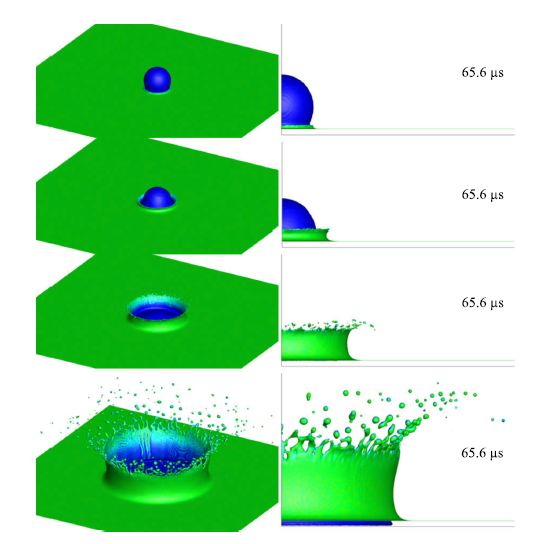 Numerical simulation of the head-on collision of a diesel oil
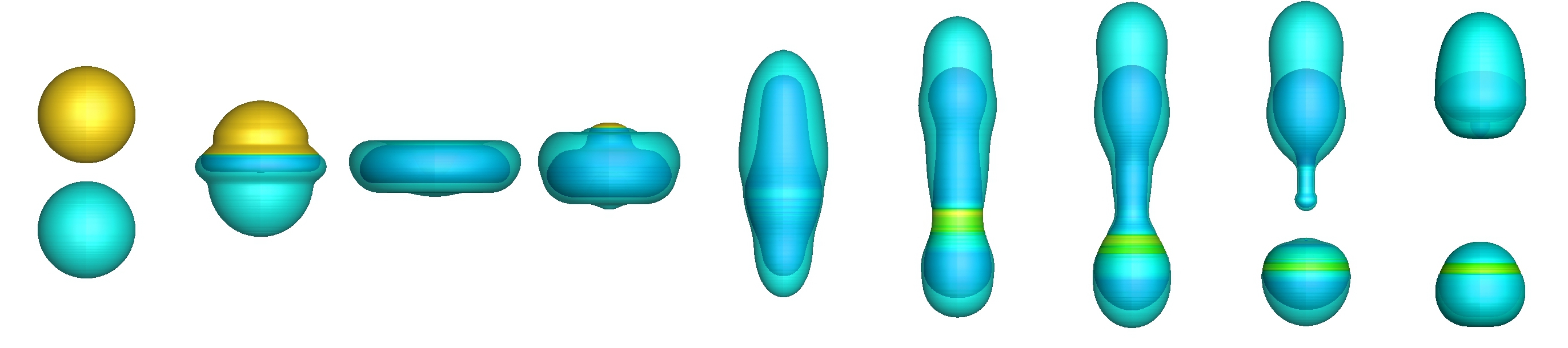
drop (cyan) with a water drop (gold) and resulting encapsulation.
Weber Number equals 9.6, 45.3, and 58.9 for the top, middle and
bottom rows respectively. The computational grid is a block structured
dynamic adaptive mesh with 48x288 coarse grid cells and 2 additional
levels of adaptivity (effective fine grid resolution is 192x1152,
148 cells per initial drop diameter).
Our results are in agreement with the experimental results from
R.H. Chen, C.T. Chen, Experiments in Fluids, volume 41, p. 453-461 (2006).
We capture the correct transition point for reflexive separation.
Simulations are done in 3d axisymmetric (RZ) coordinate system.
(work with G. Li, Y. Lian, Y. Guo, M. Jemison, T. Helms, M. Arienti)
Numerical simulation of the head-on collision of a diesel oil
drop (cyan) with a water drop (gold) and resulting encapsulation.
Weber Number equals 9.6, 45.3, and 58.9 for the top, middle and
bottom rows respectively. The computational grid is a block structured
dynamic adaptive mesh with 48x288 coarse grid cells and 2 additional
levels of adaptivity (effective fine grid resolution is 192x1152,
148 cells per initial drop diameter).
Our results are in agreement with the experimental results from
R.H. Chen, C.T. Chen, Experiments in Fluids, volume 41, p. 453-461 (2006).
We capture the correct transition point for reflexive separation.
Simulations are done in 3d axisymmetric (RZ) coordinate system.
(work with G. Li, Y. Lian, Y. Guo, M. Jemison, T. Helms, M. Arienti)


 Numerical simulation of multiphase flow (click picture for animation):
Bending laminar liquid jet in
high speed gas cross-flow; velocity ratio 10:1, density ratio 1:1000.
Adaptive mesh refinement and Parallel computing. Base grid:
256x128x128 plus 3 levels of refinement.
(with M. Arienti (UTRC), V. Mihalef (Rutgers) , M. Soteriou (UTRC)).
Comparison with experiment, which is which!
Numerical simulation of multiphase flow (click picture for animation):
Bending laminar liquid jet in
high speed gas cross-flow; velocity ratio 10:1, density ratio 1:1000.
Adaptive mesh refinement and Parallel computing. Base grid:
256x128x128 plus 3 levels of refinement.
(with M. Arienti (UTRC), V. Mihalef (Rutgers) , M. Soteriou (UTRC)).
Comparison with experiment, which is which!
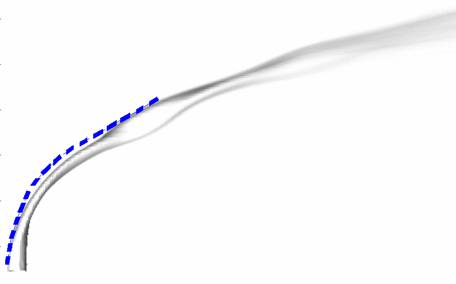
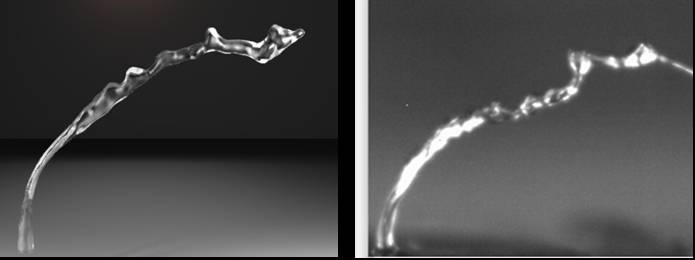 More comparison with experiment; density ratio is 1:1000, velocity
ratio 10:1.
More comparison with experiment; density ratio is 1:1000, velocity
ratio 10:1.
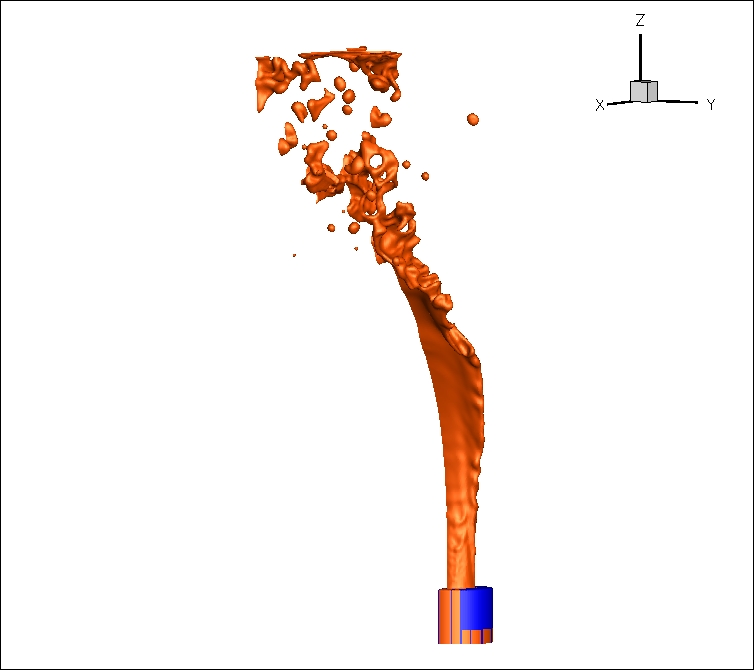
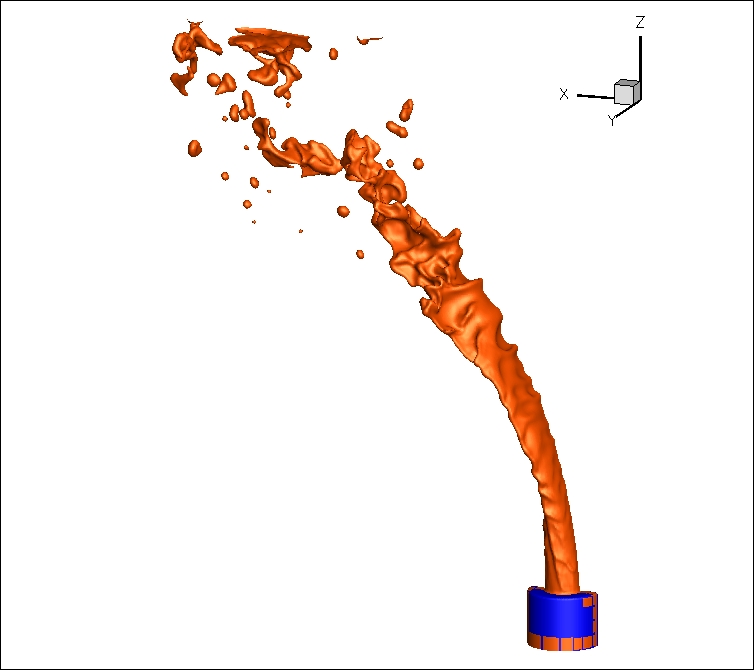
 Bending turbulent liquid jet in high speed gas cross-flow; velocity ratio
7:1, density ratio 1:1000. Dynamic Adaptive mesh refinement and parallel
computing techniques are used to accelerate the simulation. This simulation
was carried out on a single 4 core computer.
Base grid 64x16x32 (symmetry assumed at y=0)
plus 4 levels of refinement. Simulation uses
the ``hybrid level set and volume constraint'' method for representing and
updating the gas/liquid interface. The maximum grid size allowed is 16,
and the blocking factor is 4. At t=0, there are 88 grids on the finest
level containing 161856 cells. At t=1.2 ms, there are 993 grids on the finest
level containing 1486656 cells. The pressure projection step consumes
2.1E-5 seconds per cell at t=0 and 3.5E-5 seconds per cell at t=1.2.
(with Y. Wang, S. Simakhina, A. Duffy, X. Li (UTRC), H. Gao (UTRC),
M. Soteriou (UTRC)).
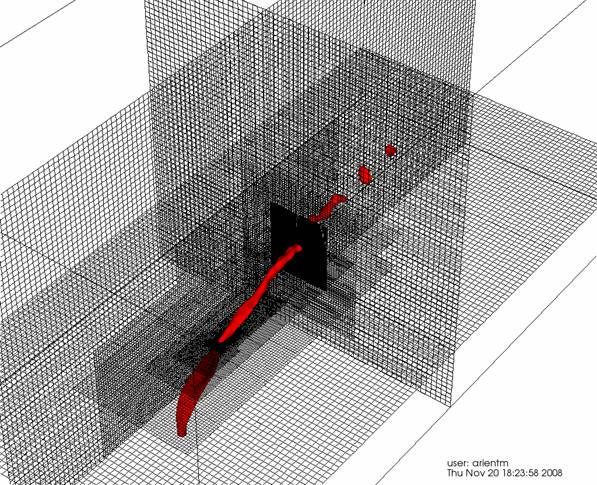
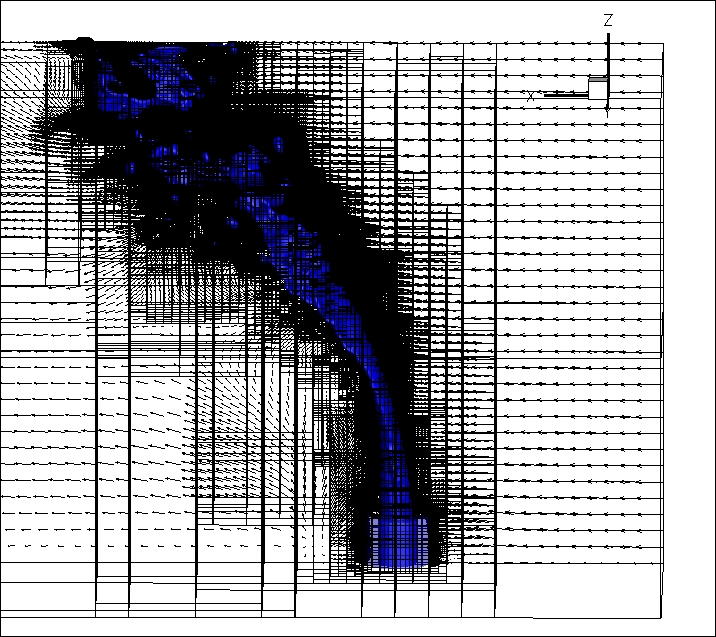
Illustration of hierarchical grid structure at t=1.2, gas/liquid interface,
and velocity along the y=0 slice.
Bending turbulent liquid jet in high speed gas cross-flow; velocity ratio
7:1, density ratio 1:1000. Dynamic Adaptive mesh refinement and parallel
computing techniques are used to accelerate the simulation. This simulation
was carried out on a single 4 core computer.
Base grid 64x16x32 (symmetry assumed at y=0)
plus 4 levels of refinement. Simulation uses
the ``hybrid level set and volume constraint'' method for representing and
updating the gas/liquid interface. The maximum grid size allowed is 16,
and the blocking factor is 4. At t=0, there are 88 grids on the finest
level containing 161856 cells. At t=1.2 ms, there are 993 grids on the finest
level containing 1486656 cells. The pressure projection step consumes
2.1E-5 seconds per cell at t=0 and 3.5E-5 seconds per cell at t=1.2.
(with Y. Wang, S. Simakhina, A. Duffy, X. Li (UTRC), H. Gao (UTRC),
M. Soteriou (UTRC)).
Illustration of hierarchical grid structure at t=1.2, gas/liquid interface,
and velocity along the y=0 slice.
 Animation of turbulent jet in a cross flow time up to 1.30ms.
(animation is the concatenation of 4 parts)
Animation of turbulent jet in a cross flow time up to 1.30ms.
(animation is the concatenation of 4 parts)
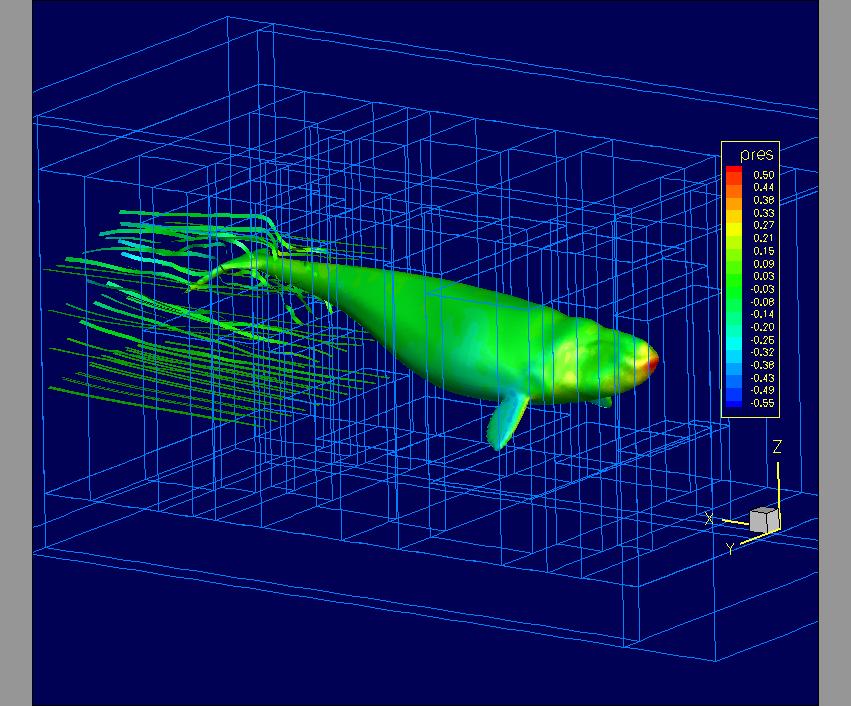
 Numerical simulation of flow past an animated North America Right Whale
(click picture for animation). Two levels of adaptivity. This is
work with Anna McGregor, Dr. Ross McGregor, Dr. Doug Nowacek from the
Duke Marine
Labs, Austen Duffy (graduate student, Florida State applied math), and
Dr. Gorden Erlebacher (Florida State, Department of Scientific Computing).
Numerical simulation of flow past an animated North America Right Whale
(click picture for animation). Two levels of adaptivity. This is
work with Anna McGregor, Dr. Ross McGregor, Dr. Doug Nowacek from the
Duke Marine
Labs, Austen Duffy (graduate student, Florida State applied math), and
Dr. Gorden Erlebacher (Florida State, Department of Scientific Computing).
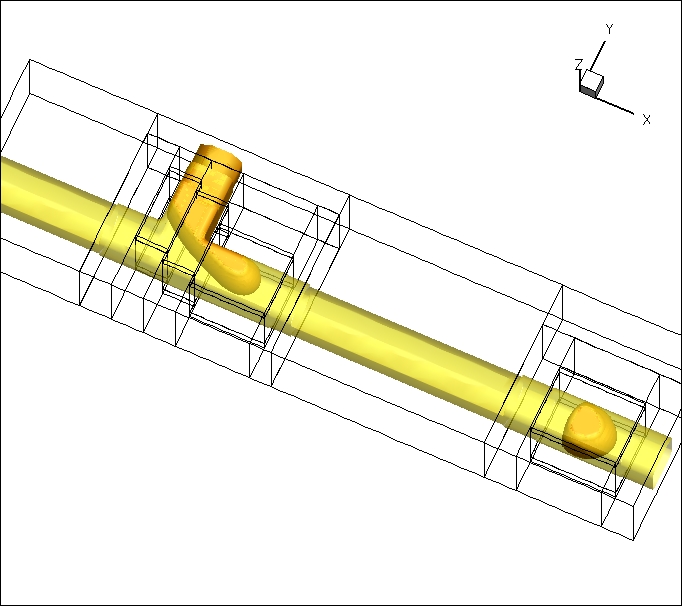
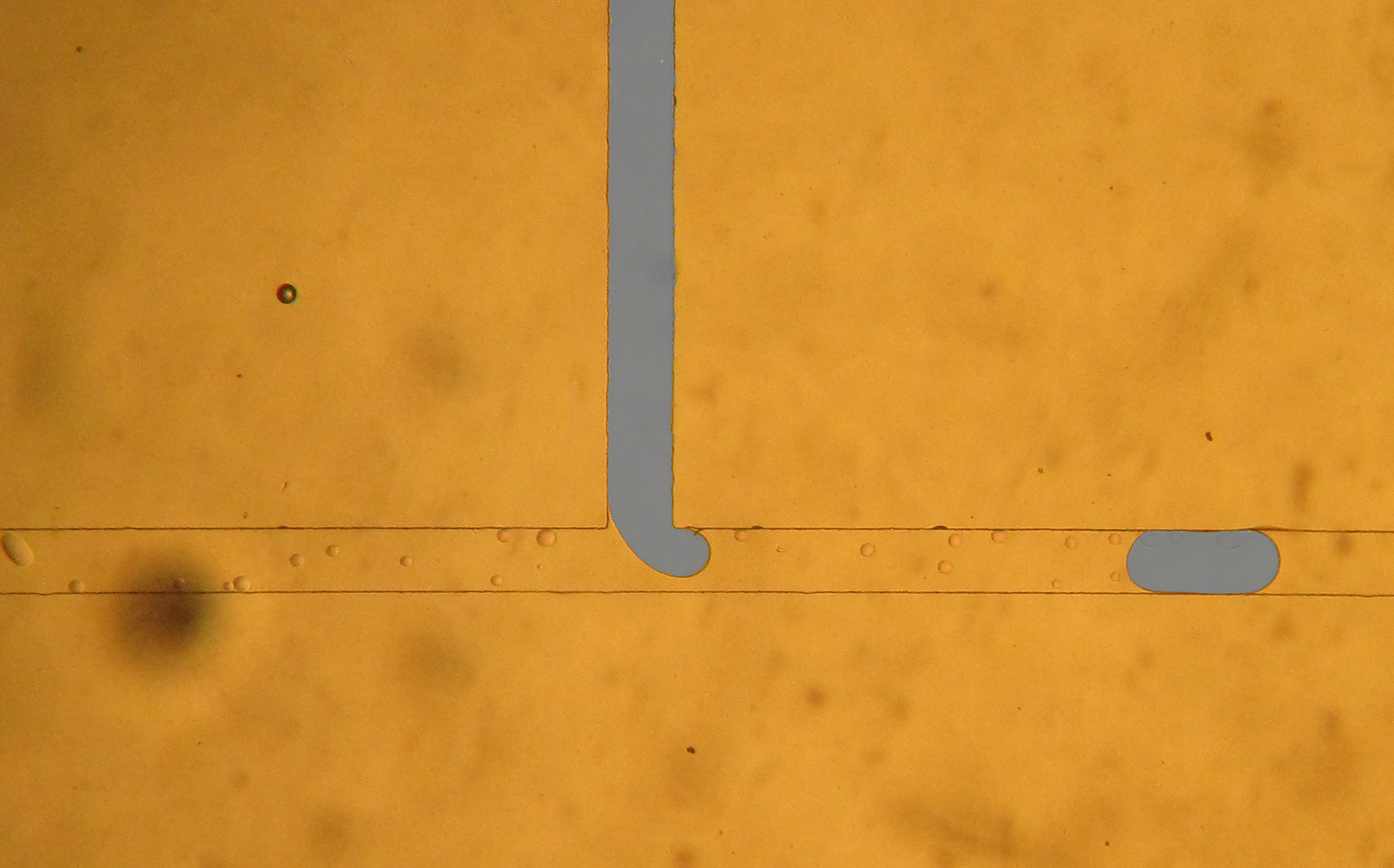
 Numerical simulation of droplet formation in a T-junction
(click picture for animation). Continuous phase
fluid travels 10 times faster than the "droplet" fluid. Square cross
section 1E-4 cm^2. Effective fine grid resolution: 256x64x32.
Contact angle: 135 degrees.
Size of the droplets consistently have an effective diameter of 0.011cm
which is in agreement with experiment and simulation reported by
van der Graaf et al, Langmuir 2006, 22(9), 4144-4152 (continuous
phase flow rate v_max=8.3cm/s). This work with
Dr. Austen Duffy (recent PhD, Florida State applied math), and
Dr. Michael Roper (Florida State, Department of chemistry and biochemistry).
Numerical simulation of droplet formation in a T-junction
(click picture for animation). Continuous phase
fluid travels 10 times faster than the "droplet" fluid. Square cross
section 1E-4 cm^2. Effective fine grid resolution: 256x64x32.
Contact angle: 135 degrees.
Size of the droplets consistently have an effective diameter of 0.011cm
which is in agreement with experiment and simulation reported by
van der Graaf et al, Langmuir 2006, 22(9), 4144-4152 (continuous
phase flow rate v_max=8.3cm/s). This work with
Dr. Austen Duffy (recent PhD, Florida State applied math), and
Dr. Michael Roper (Florida State, Department of chemistry and biochemistry).
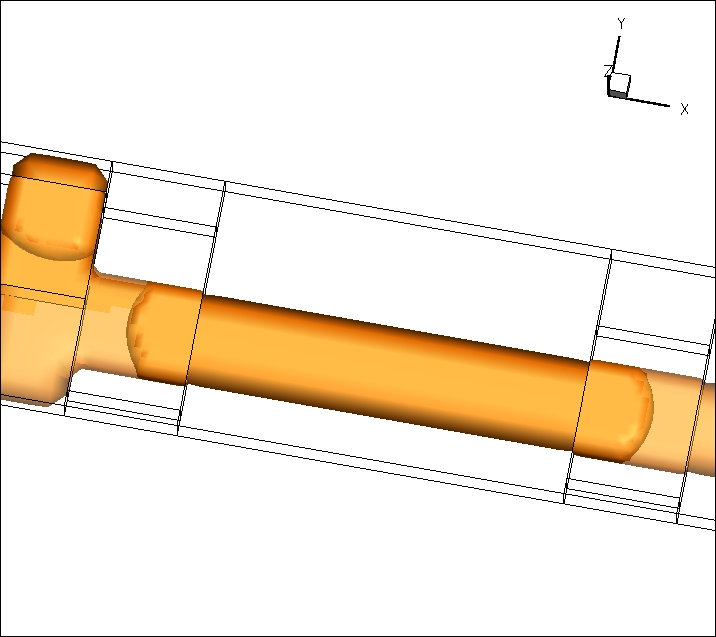
 Numerical simulation of droplet formation in a head-on microfluidic device
(click picture for animation). Continuous phase
fluid (water) enters from the bottom (Q=0.05 micro-liter/min) and dispersed
phase fluid (oil) enters from the top (Q=0.1 micro-liter/min). Channel height
is 10 microns and channel width is 30 microns. Contact angle is prescribed
at 135 degrees. The numerical algorithm predicts a droplet length of
162 microns. Experiments from Figure 7 of Shui et al (Lab on a chip, 2009)
show droplets with length 143 microns.
Effective fine grid resolution: 128x32x4.
This work with
Dr. Austen Duffy (recent PhD, Florida State applied math),
Matt Jemison (PhD student, Florida State applied math) and
Dr. Michael Roper (Florida State, Department of chemistry and biochemistry).
Numerical simulation of droplet formation in a head-on microfluidic device
(click picture for animation). Continuous phase
fluid (water) enters from the bottom (Q=0.05 micro-liter/min) and dispersed
phase fluid (oil) enters from the top (Q=0.1 micro-liter/min). Channel height
is 10 microns and channel width is 30 microns. Contact angle is prescribed
at 135 degrees. The numerical algorithm predicts a droplet length of
162 microns. Experiments from Figure 7 of Shui et al (Lab on a chip, 2009)
show droplets with length 143 microns.
Effective fine grid resolution: 128x32x4.
This work with
Dr. Austen Duffy (recent PhD, Florida State applied math),
Matt Jemison (PhD student, Florida State applied math) and
Dr. Michael Roper (Florida State, Department of chemistry and biochemistry).
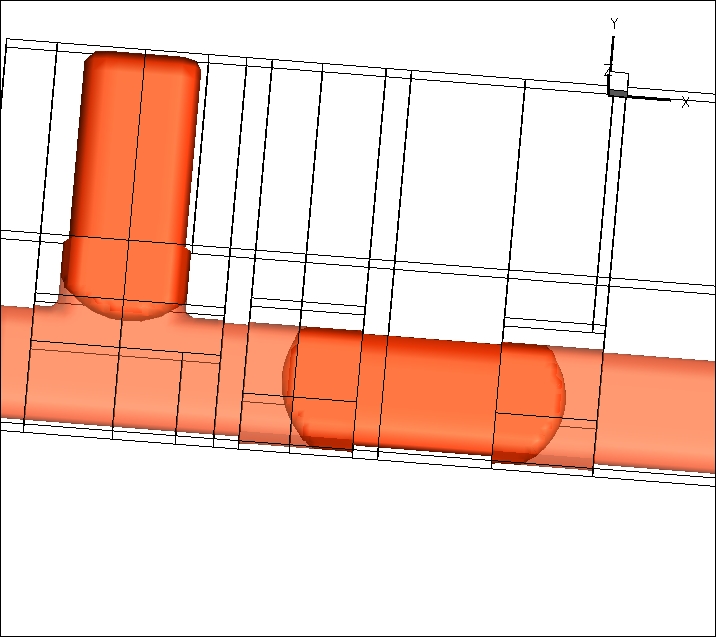
 Numerical simulation together with experiments (conducted in M. Ropers' lab)
for droplet formation in a T-junction
(click picture for animation). Continuous phase
fluid (oil) enters from the left (Q=1.3 micro-liter/min) and dispersed
phase fluid (water) enters from the top (Q=0.3 micro-liter/min).
The channel has a trapezoidal cross
section with dimensions close to 185 microns wide by 37 microns high.
The contact angle is prescribed at 135 degrees. The numerical
algorithm predicts a droplet length of 415 microns. Experiments show
a droplet length of 444 microns. Effective fine grid resolution: 128x64x4.
This work with
Dr. Austen Duffy (recent PhD, Florida State applied math), and
Dr. Michael Roper (Florida State, Department of chemistry and biochemistry).
Numerical simulation together with experiments (conducted in M. Ropers' lab)
for droplet formation in a T-junction
(click picture for animation). Continuous phase
fluid (oil) enters from the left (Q=1.3 micro-liter/min) and dispersed
phase fluid (water) enters from the top (Q=0.3 micro-liter/min).
The channel has a trapezoidal cross
section with dimensions close to 185 microns wide by 37 microns high.
The contact angle is prescribed at 135 degrees. The numerical
algorithm predicts a droplet length of 415 microns. Experiments show
a droplet length of 444 microns. Effective fine grid resolution: 128x64x4.
This work with
Dr. Austen Duffy (recent PhD, Florida State applied math), and
Dr. Michael Roper (Florida State, Department of chemistry and biochemistry).
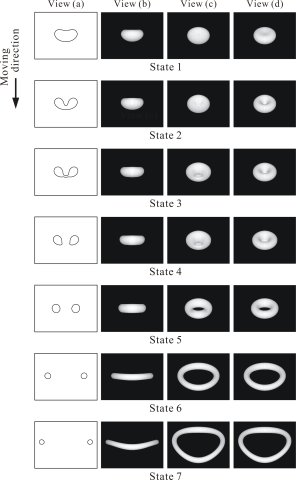
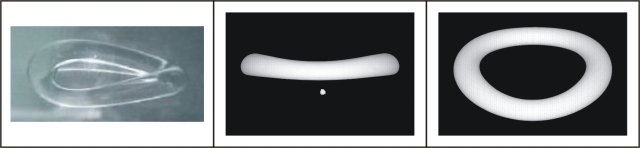
 Numerical simulation of vortex rings of a heavy drop falling in
a viscous liquid. Simulations agree with experiments
reported by Baumann, Joseph, Mohr and Renardy, Phys. of Fluids A,
volume 4, p. 567-580 (1992)!
(with M. Ohta, Y. Akama, and Y. Yoshida
(Muroran Institute of Technology))
Numerical simulation of vortex rings of a heavy drop falling in
a viscous liquid. Simulations agree with experiments
reported by Baumann, Joseph, Mohr and Renardy, Phys. of Fluids A,
volume 4, p. 567-580 (1992)!
(with M. Ohta, Y. Akama, and Y. Yoshida
(Muroran Institute of Technology))
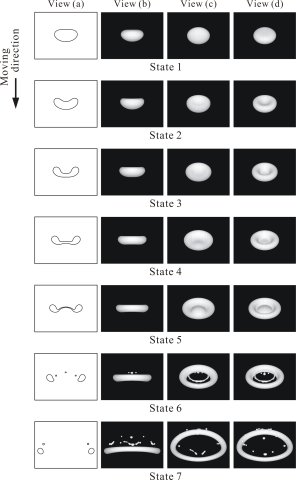
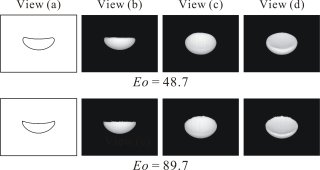 Numerical simulation of unstable light drops rising in a viscous liquid.
Simulations agree with experiments!
(with M. Ohta, Y. Akama, Y. Yoshida
(Muroran Institute of Technology))
Morton number=0.2, Eotvos number=52.8
Numerical simulation of unstable light drops rising in a viscous liquid.
Simulations agree with experiments!
(with M. Ohta, Y. Akama, Y. Yoshida
(Muroran Institute of Technology))
Morton number=0.2, Eotvos number=52.8
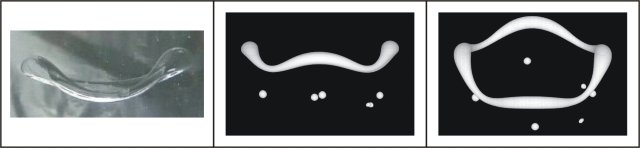 Morton number=0.0002, Eotvos number=19.2
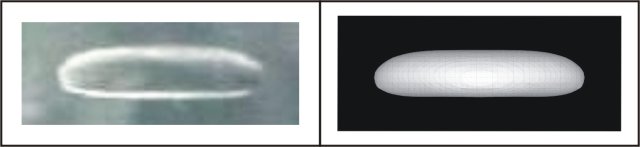 Morton number=0.0002, Eotvos number=21.8
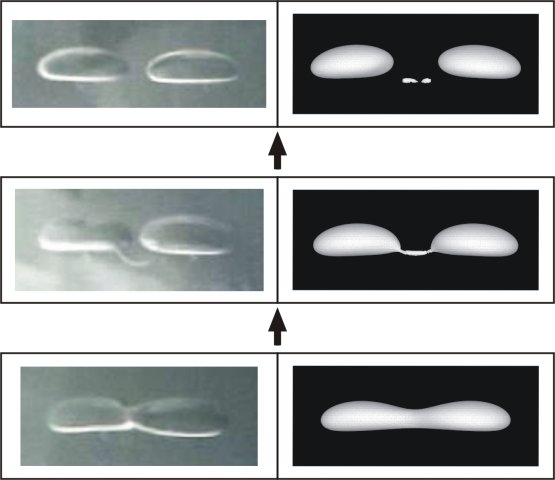 Morton number=0.0002, Eotvos number=22.9
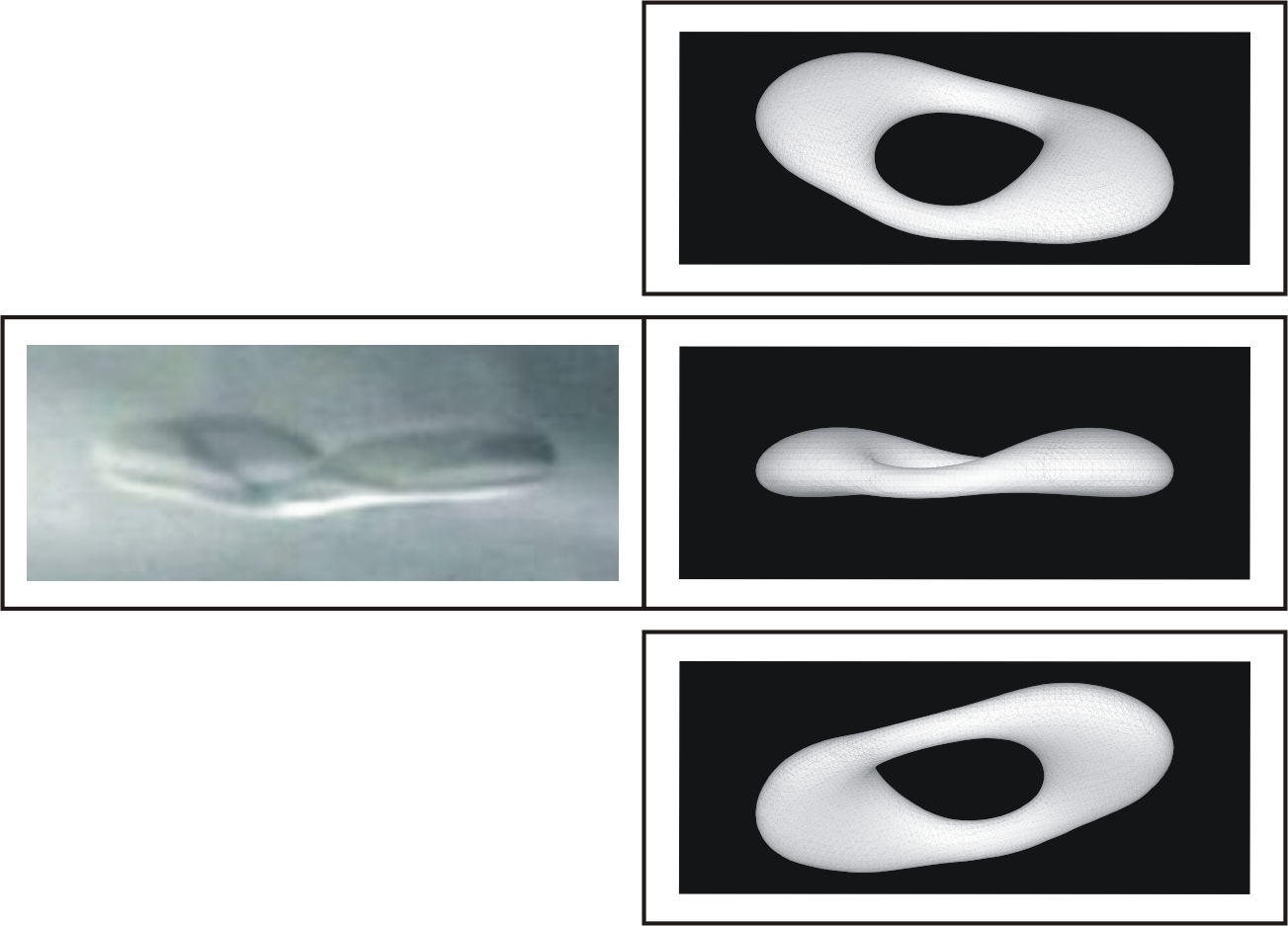 Morton number=2.2, Eotvos number=70.1
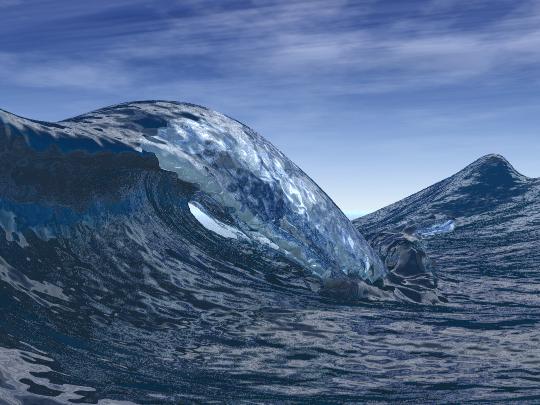
 Numerical simulation of multiphase flow: Animation and Control of
Breaking Waves (with V. Mihalef and D. Metaxas, Rutgers)
Numerical simulation of multiphase flow: Animation and Control of
Breaking Waves (with V. Mihalef and D. Metaxas, Rutgers)
 Numerical simulation of multiphase flow (click picture for animation):
Boiling and solid-fluid interaction
(with V. Mihalef, S. Kadioglu, B. Unlusu, D. Metaxas, M.Y. Hussaini)
Numerical simulation of multiphase flow (click picture for animation):
Boiling and solid-fluid interaction
(with V. Mihalef, S. Kadioglu, B. Unlusu, D. Metaxas, M.Y. Hussaini)
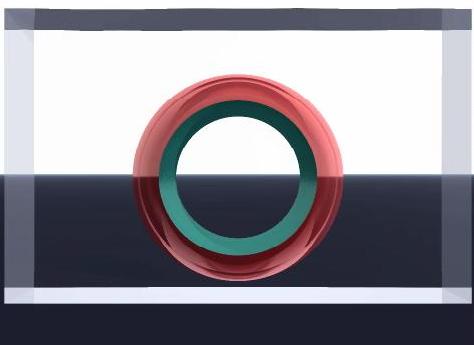 For this boiling movie, the temperature of the solid changes from hot to
cold (click picture for animation).
Numerical simulation of multiphase flow
(click picture for animation): solid-fluid interaction,
contact line dynamics
(with V. Mihalef, S. Kadioglu, D. Metaxas)
For this boiling movie, the temperature of the solid changes from hot to
cold (click picture for animation).
Numerical simulation of multiphase flow
(click picture for animation): solid-fluid interaction,
contact line dynamics
(with V. Mihalef, S. Kadioglu, D. Metaxas)
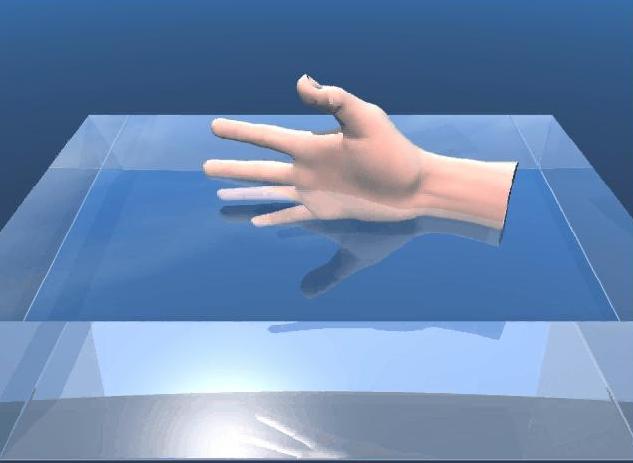 Numerical simulation of multiphase flow
(click picture for animation): solid-fluid interaction
(with V. Mihalef, S. Kadioglu, D. Metaxas)
Numerical simulation of multiphase flow
(click picture for animation): solid-fluid interaction
(with V. Mihalef, S. Kadioglu, D. Metaxas)
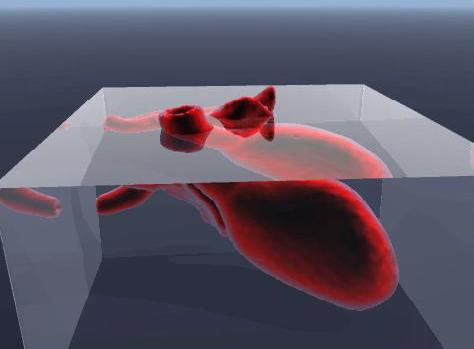 Numerical simulation of multiphase flow
(click picture for animation): solid-fluid interaction
(with V. Mihalef, S. Kadioglu, D. Metaxas)
Numerical simulation of multiphase flow
(click picture for animation): solid-fluid interaction
(with V. Mihalef, S. Kadioglu, D. Metaxas)
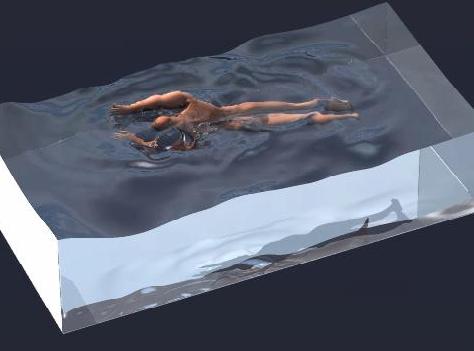 Numerical simulation of multiphase flow
(click picture for animation): underwater explosion,
shock waves and solid-fluid interaction
(with S. Kadioglu, D. Rubin, J. Wright)
Numerical simulation of multiphase flow
(click picture for animation): underwater explosion,
shock waves and solid-fluid interaction
(with S. Kadioglu, D. Rubin, J. Wright)
 Numerical simulation of multiphase flow
(click picture for animation): underwater explosion,
shock waves and cavitation effects
(with S. Kadioglu, D. Rubin, J. Wright)
Numerical simulation of multiphase flow
(click picture for animation): underwater explosion,
shock waves and cavitation effects
(with S. Kadioglu, D. Rubin, J. Wright)
 Numerical simulation of multiphase flow
(click pictures for animation): underwater implosion,
shock waves and solid-fluid interaction
(with S. Kadioglu, D. Rubin, J. Wright)
Numerical simulation of multiphase flow
(click pictures for animation): underwater implosion,
shock waves and solid-fluid interaction
(with S. Kadioglu, D. Rubin, J. Wright)

 Implosion with endcaps included... (click for animation)
 Numerical simulation of multiphase flow (click for animation):
milk-drop simulation
(with V. Mihalef, D. Metaxas, E. Jimenez)
Numerical simulation of multiphase flow (click for animation):
milk-drop simulation
(with V. Mihalef, D. Metaxas, E. Jimenez)
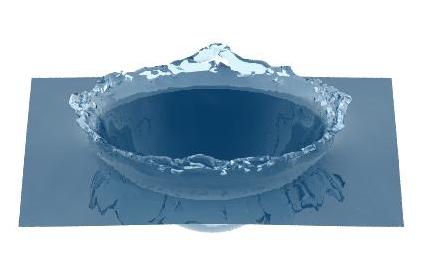 Numerical simulation of multiphase flow: computation of ship waves
(with D. Dommermuth; visualized by K. Beason, CS)
Numerical simulation of multiphase flow: computation of ship waves
(with D. Dommermuth; visualized by K. Beason, CS)
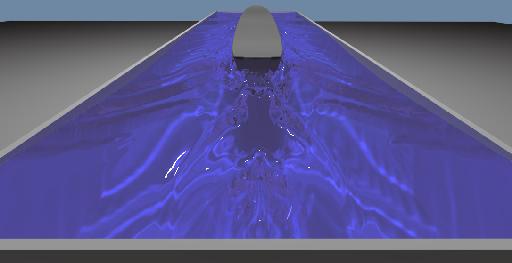
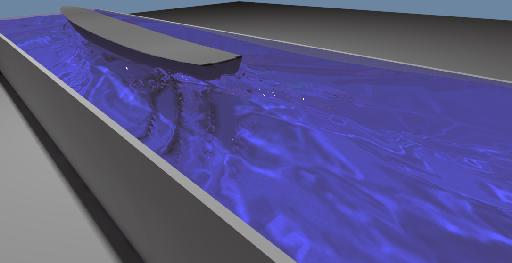 Click here for more Movies of flow around a DDG 5415 Navy Ship. Visualization
generated by Kevin Beason, CS department
Click here for more Movies of flow around a DDG 5415 Navy Ship. Visualization
generated by Kevin Beason, CS department
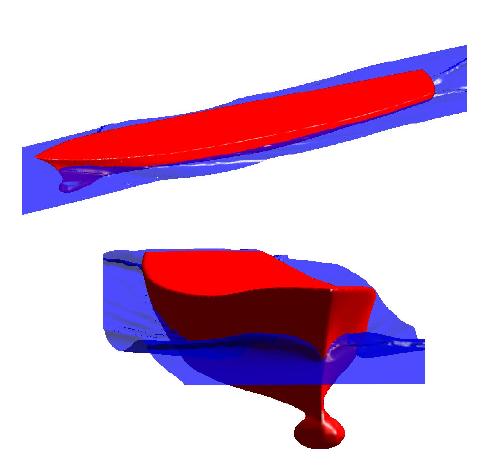
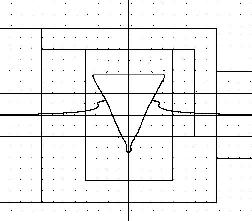 Numerical simulation of multiphase flow: computation of
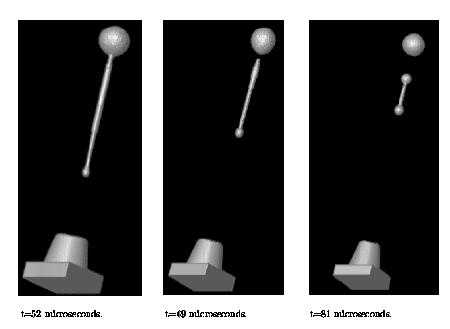
microscale jetting in ink-jet device
(with E.G. Puckett and J. Andrews)
Numerical simulation of multiphase flow: computation of
microscale jetting in ink-jet device
(with E.G. Puckett and J. Andrews)
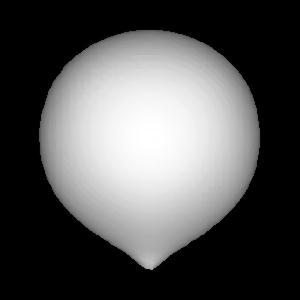
Numerical simulation of multiphase flow: non-newtonian (Oldroyd-B) bubbles (with M. Ohta)
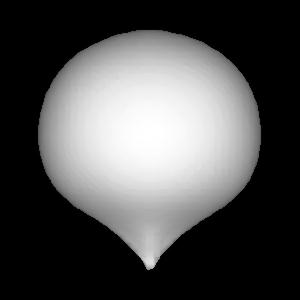
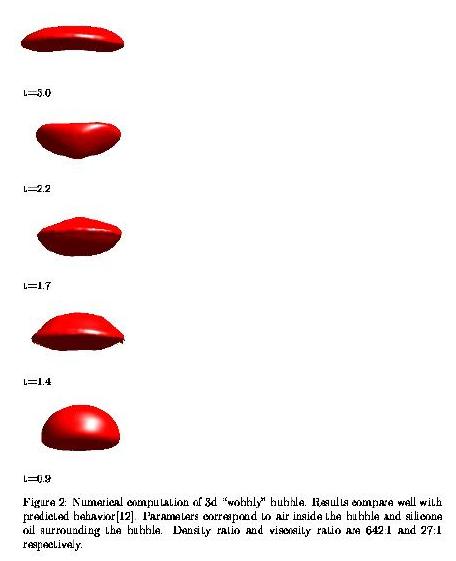
Numerical simulation of multiphase flow: wobbly bubble (with M. Ohta)
Please send any comments, questions or requests for more information to me at sussman@math.fsu.edu.
Tutorial for GIT version control program Pictures from trip to Muroran, Japan (2006) Tallahassee windsurfing club (Shell Point Sailboard Club SPSC) Shell point shore based tower Station SHPF1 Shell point tides (tides4fishing) Shell point tides (tideschart) NOAA Tallahassee Regional Airport weather observations Courtesy FSU EOAS NOAA hurricane data