Reliable scientific computing for multiscale and multiphysics PDEs: numerical methods, model–data integration, optimization, and scientific machine learning.
Research Vision
I develop reliable scientific-computing methods for multiscale and multiphysics PDEs.
Keywords: finite element methods; multiphysics and coupled systems; inverse problems and data assimilation; optimization and control; scientific machine learning.
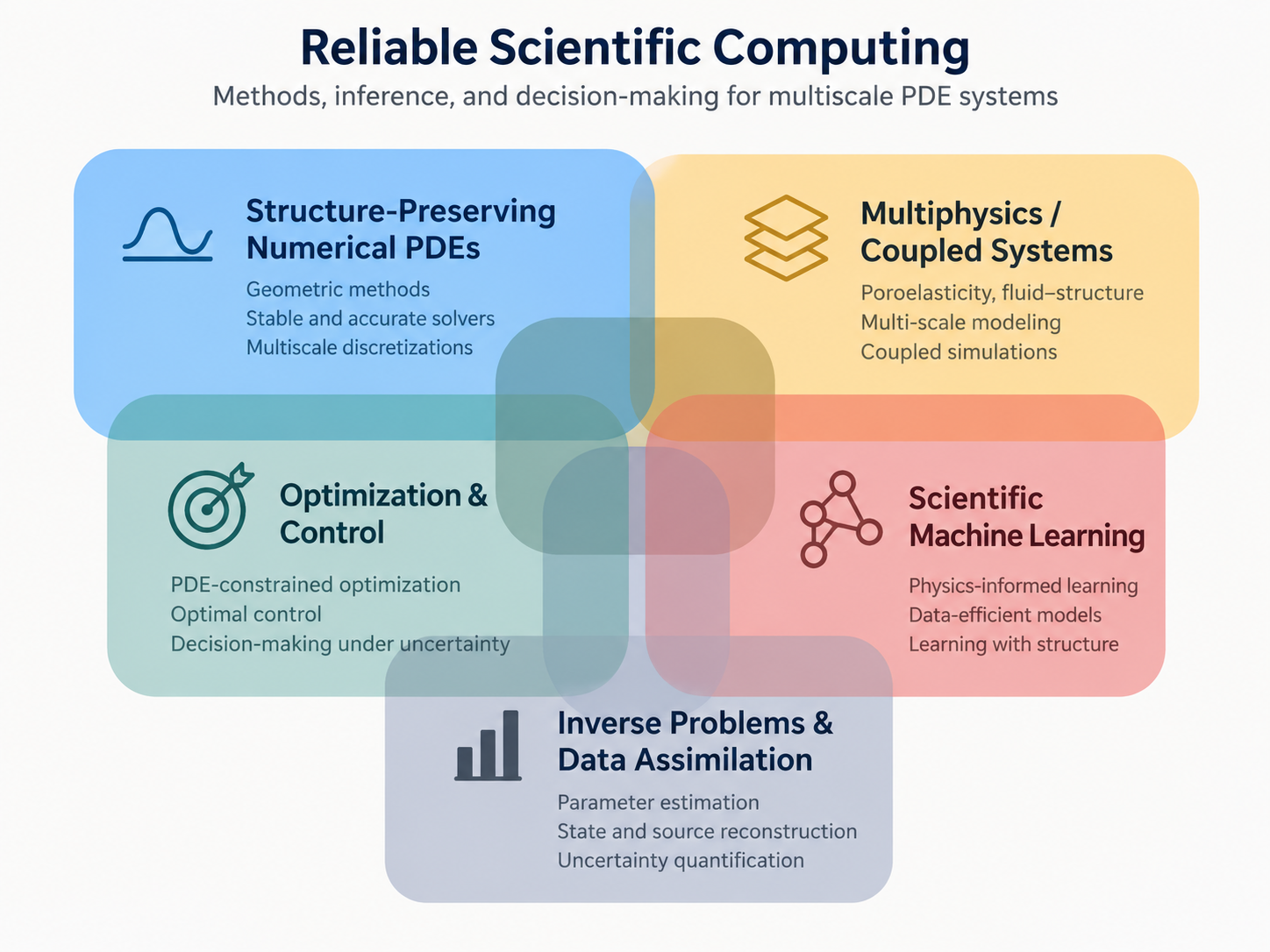
A schematic view of the main directions in my research program.
Funded Research and Collaborative Programs
Current support spans trustworthy scientific AI, computational mathematics, multiphysics energy systems, and research training, with prior NSF and DOE awards supporting numerical PDEs, poromechanics, fracture, and subsurface energy.
Current Major Funded Research
Major externally supported projects in which I serve as PI or Co-PI.
DOE Office of Advanced Scientific Computing Research (AI for Science)09/2026–08/2029
DE-SC0026871
From Uncertainty to Trust: A Scalable Stochastic Computing Framework for Uncertainty Reduction in Artificial Intelligence
PI: Feng Bao (Florida State University), Co-PIs: Sanghyun Lee, Bryan Quaife, Hristo Chipilski (Florida State University). Total budget: $1 million
DOE GENESIS Mission09/2026–05/2027
AI-Powered Manufacturing of High Temperature Superconductors for Fusion Energy
PI: Fumitake Kametani (Florida State University). FSU Co-PI: Sanghyun Lee. Collaborators include researchers from the National High Magnetic Field Laboratory, High Temperature Superconductors, Inc., and Lawrence Berkeley National Laboratory. Total budget: $0.75 million.
NRF Basic Science Research Program / Basic Research Lab07/2026–06/2029
RS-2026-25505849
Operator-Composition-Based Theoretical Analysis of Deep Neural Networks: Focusing on the Transformer
PI: Sunghwan Moon (Kyungpook National University, South Korea), Co-PIs: Sanghyun Lee (Florida State University), B. Kim, J. Kang (Kyungpook National University). Total budget: 1.5 billion won
DOE Science Foundations for the Energy Earthshots10/2023–10/2027
DE-SC0024703
Advanced Multi-Physics Machine Learning for Subsurface Energy Systems Across Scales
Collaborative DOE project with the University of Texas at El Paso, Florida State University, Sandia National Laboratories, and the University of Utah; Sanghyun Lee serves as Co-PI at Florida State University.
Sanghyun Lee (Florida State University) and Sunghwan Moon (Kyungpook National University, Republic of Korea)
Selected Completed Funding
National Science Foundation DMS08/2019–07/2022
DMS-1913016
Fluid-filled Fracture Propagation with a Phase-Field Approach in Subsurface by Employing Nonlinear Strain-Limiting Models and Enriched Galerkin Methods
Florida State University First Year Assistant Professor Program (FYAP)05/2018–08/2018
CRC: 041950
Optimal Error Estimate of Flow Problems with Dirac Sources in Subsurface for Discontinuous and Enriched Galerkin Methods
Current Research Areas
My current research program is organized around six closely connected themes, from structure-preserving numerical PDEs to data-driven and decision-oriented scientific computing.
DeepONet and finite-element operator learning, reduced and multi-fidelity models, physics- and structure-guided learning, and verification of learned PDE models.
PDE-constrained optimization, state constraints, goal-oriented error estimation and adaptivity, active-set solvers, reduced models, and decisions under uncertainty.
Mathematical and computational challenges in subsurface energy systems, geothermal processes, porous-media fracture, and emerging superconducting-material and fusion applications.
Earlier work includes projection methods for incompressible Navier–Stokes equations, level-set methods for multiphase flow, Newtonian and non-Newtonian bouncing jets, and viscous fingering. These pages are retained as an archive of earlier projects, including simulations and visualizations.