Multiphysics, Poromechanics & Fracture
Mathematical models and numerical algorithms for coupled flow, deformation, heat, transport, chemistry, and fracture in heterogeneous porous materials.
Overview
Many subsurface, geomechanical, and energy systems are governed by strongly coupled processes acting across different spatial and temporal scales. My research develops finite element formulations and coupling algorithms for poroelasticity, thermo-poroelasticity, reactive porous-media systems, and fluid-filled fracture propagation.
A recurring objective is to combine physically meaningful discretization with computational efficiency. This includes locally conservative flow and heat discretizations, locking-free mechanics, fixed-stress and multirate splitting, adaptive phase-field fracture, scalable linear and nonlinear solvers, and reduced representations for repeated multiphysics simulation.
Poromechanics and Thermo-Poroelasticity
My work on poromechanics began with locally conservative enriched Galerkin formulations for Biot-type systems and later developed toward locking-free methods, heterogeneous permeability alteration, thermo-poroelasticity, and efficient coupling strategies. The numerical methods are designed to preserve local mass conservation while remaining robust as the solid approaches the nearly incompressible regime.
- Poroelasticity. Locally conservative discretization of coupled flow and deformation.
- Locking-free mechanics. Parameter-robust formulations for nearly incompressible materials.
- Thermo-poroelasticity. Coupled momentum, mass, and energy equations with physics-preserving discretization.
- Heterogeneity. Interfaces, permeability contrasts, localized pressure effects, and global-local coupling.
Phase-Field Fracture in Porous Media
Phase-field methods provide a variational framework for fracture nucleation, growth, branching, and interaction without explicit tracking of a sharp crack surface. My work has focused on fluid-filled fracture propagation in porous media and on coupling fracture evolution with flow, mechanics, transport, and thermal effects.
Multiphysics phase-field fracture framework
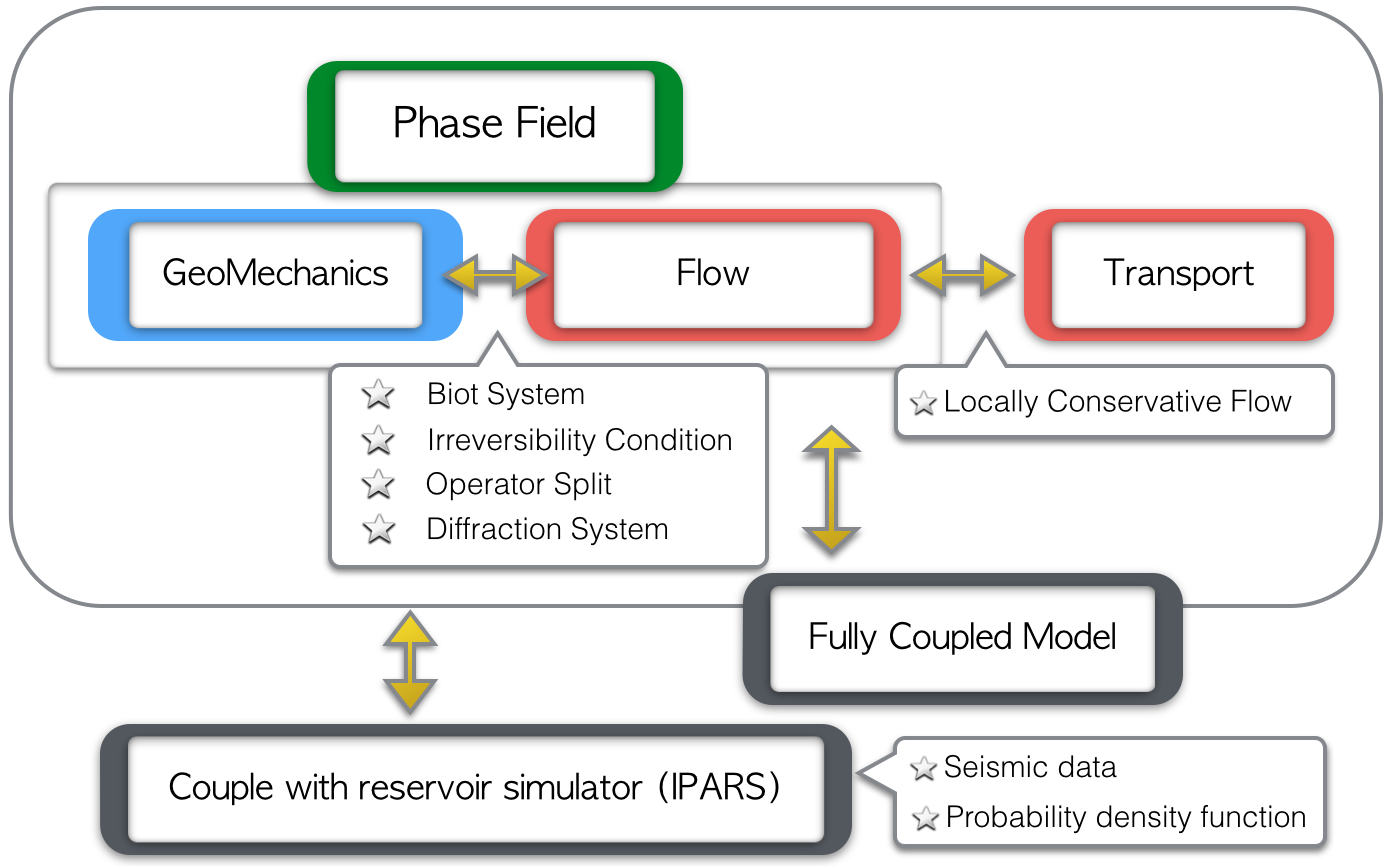
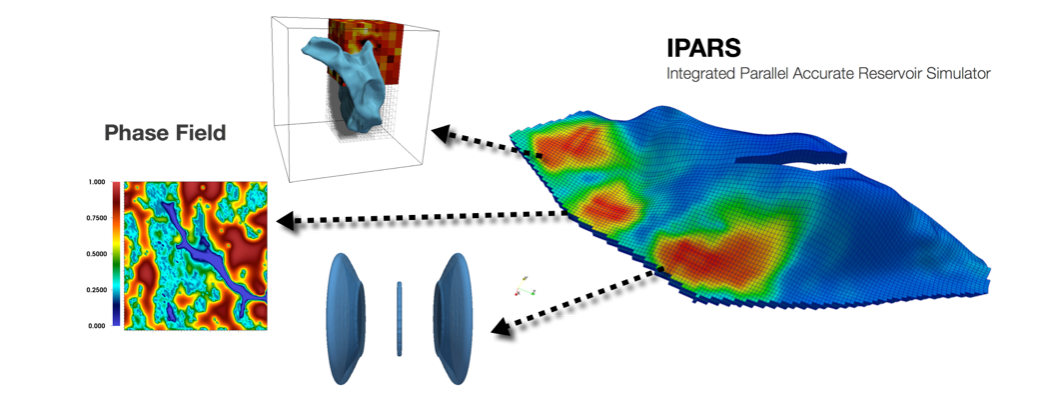
The IPACS framework developed an adaptive, parallel phase-field discretization for fracture propagation in porous media. Subsequent work extends this direction to poromechanical and thermo-hydro-mechanical fracture, including fixed-stress coupling, fracture-width characterization, matrix-free solvers, and multirate strategies.
Coupling Algorithms and Scalable Solvers
Multiphysics models are often too expensive to solve monolithically at every scale and time step. I therefore study sequential and iterative coupling strategies that retain stability while exposing the block structure of the governing PDEs.
- fixed-stress splitting for poroelastic and fracture systems;
- stability analysis for poroelastodynamic splitting schemes;
- multirate coupling for hydraulic-fracture evolution;
- matrix-free geometric multigrid on locally refined meshes;
- non-intrusive global-local coupling when multiphysics effects are spatially localized.
Adaptive fracture computation
THM and THMC Coupling
Recent work extends the fracture and poromechanics program from hydro-mechanical coupling to thermo-hydro-mechanical (THM) and thermo-hydro-mechanical-chemical (THMC) systems. These models couple deformation, pressure, temperature, fracture evolution, and—in reactive settings—chemical processes that alter material properties and transport pathways.
This direction is motivated by geothermal energy, reactive fracture, and other subsurface systems in which evolving thermal and chemical fields feed back into mechanics and flow.
Current Directions
- Fracture width and interface accuracy. Improved geometric and physical characterization of fluid-filled phase-field fractures.
- Multirate multiphysics. Stable coupling when physical processes evolve on different time scales.
- Localized multiphysics. Global-local strategies that resolve expensive coupled physics only where necessary.
- THM/THMC energy systems. Predictive models for geothermal and other subsurface applications with evolving fractures and material properties.
Selected Publications
- Convergence Analysis of a Multirate Undrained-Splitting Scheme for Hydraulic Fracture Propagation in Fractured Poroelastic Media. Submitted.
- Adaptive Matrix-Free Simulations of Fluid-Filled Phase-Field Fractures with Fixed-Stress Coupling and Fracture-Width Computation. International Journal for Numerical Methods in Engineering, 127, e70392, 2026.
- Non-Intrusive Global-Local Method for Poroelasticity Problems with Localized Pressure Effects. International Journal for Numerical and Analytical Methods in Geomechanics, 50, 1033-1044, 2026.
- The von Neumann Stability Analysis of the Fixed-Stress Schemes in Poroelastodynamics. International Journal for Numerical and Analytical Methods in Geomechanics, 50, 1939-1951, 2026.
- A Thermo-Flow-Mechanics-Fracture Model Employing a High-Accuracy Phase-Field Interface Approach. International Journal for Numerical Methods in Engineering, 126, e7646, 2025.
- A Phase-Field Diffraction Model for Thermo-Hydro-Mechanical Propagating Fractures. International Journal of Heat and Mass Transfer, 239, 126487, 2025.
- A Thermal-Hydraulic-Mechanical-Chemical Coupling Model for Acid Fracture Propagation Based on a Phase-Field Method. Rock Mechanics and Rock Engineering, 57, 4583-4605, 2024.
- Physics-Preserving Enriched Galerkin Method for a Fully-Coupled Thermo-Poroelasticity Model. Numerische Mathematik, 156, 949-978, 2024.
- Locking-Free and Locally-Conservative Enriched Galerkin Method for Poroelasticity. Journal of Scientific Computing, 94:26, 2023.
- IPACS: Integrated Phase-Field Advanced Crack Propagation Simulator. Computer Methods in Applied Mechanics and Engineering, 367, 113124, 2020.
Related Funded Projects
- DOE Science Foundations for the Energy Earthshots: Advanced Multi-Physics Machine Learning for Subsurface Energy Systems Across Scales (through October 2027).
- NSF DMS-2208402: Physics-Preserving Adaptive Finite Element Methods for Thermo-Poroelasticity (through January 2027).
- NSF DMS-1913016: Fluid-Filled Fracture Propagation with a Phase-Field Approach in Subsurface by Employing Nonlinear Strain-Limiting Models and Enriched Galerkin Methods.