Energy, Earth & Materials
Application-driven scientific computing for subsurface energy, geothermal systems, evolving fractures, and emerging high-temperature superconducting materials for fusion energy.
Overview
My application-driven research is centered on problems in which multiphysics coupling, heterogeneity, uncertainty, and computational cost are inseparable from the mathematics. Subsurface and geo-energy systems have been a primary application area, providing motivating problems for locally conservative discretization, poromechanics, fracture, data assimilation, reduced modeling, and scientific machine learning.
More recently, this framework is expanding toward materials and fusion-energy applications, where coupled transport, mechanics, damage, manufacturing variability, and data-driven modeling raise many of the same computational questions in a different physical setting.
Subsurface and Geo-Energy Systems
Flow, transport, deformation, and heat transfer in the subsurface are strongly affected by heterogeneous permeability, fractures, uncertain material properties, and sparse observations. My work develops numerical and data-driven methods that address these features while retaining conservation, stability, and computational efficiency.
- Flow and transport. Locally conservative simulation of single- and multiphase porous-media systems.
- Poromechanics. Coupled fluid flow and solid deformation in heterogeneous formations.
- Fracture. Phase-field models for fluid-driven and thermo-mechanical fracture propagation.
- Data and uncertainty. Assimilation, parameter estimation, and uncertainty-aware prediction for subsurface systems.
Geothermal Energy
Enhanced geothermal systems require predictive models for coupled flow, heat transfer, deformation, fracture, and operational uncertainty. Current work combines high-fidelity multiphysics simulation with reduced and learned models to support scalable computation across spatial and temporal scales.
Recent developments include thermo-hydro-mechanical fracture models, local thermal nonequilibrium heat-transfer models, and data-driven or reduced-order approaches for accelerated prediction.
Fracture, Reactive Transport, and Evolving Media
Many energy and earth systems involve interfaces and material properties that evolve dynamically. Fracture changes flow pathways; chemical reactions alter porosity and permeability; thermal loading changes stress and transport; and these changes feed back into the governing PDEs.
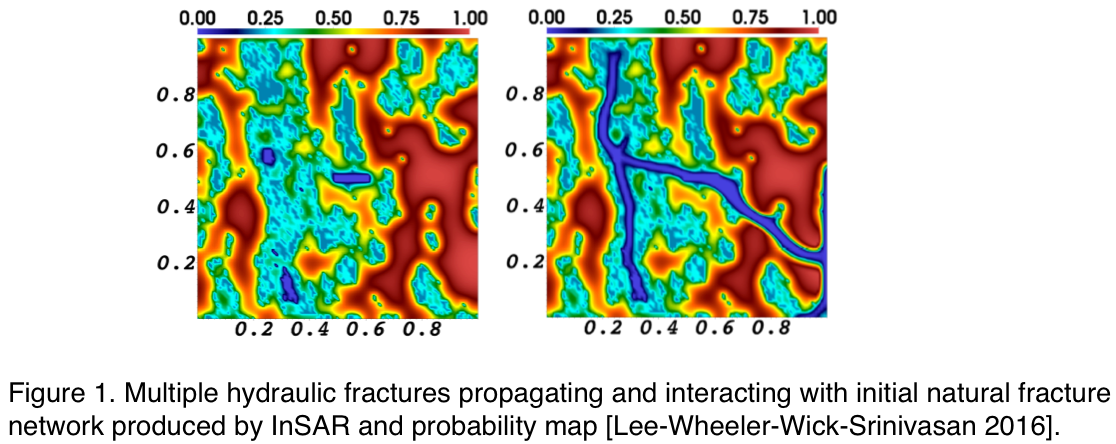
- fluid-filled fracture propagation in porous media;
- thermo-hydro-mechanical and thermo-hydro-mechanical-chemical coupling;
- reactive transport and permeability alteration;
- multiscale and adaptive computation for localized evolving features.
Coupled fracture and subsurface processes
High-Temperature Superconducting Materials and Fusion
An emerging direction applies scientific computing and machine learning to high-temperature superconducting materials for fusion-energy magnets. These materials are manufactured through complex processes in which small variations can affect electrical performance, mechanical integrity, and ultimately magnet reliability.
Current work through the DOE GENESIS Mission focuses on AI-enabled manufacturing and predictive modeling of high-temperature superconducting tapes. My role emphasizes the computational and mathematical side of the project, including model-data integration, surrogate modeling, uncertainty, and the connection between manufacturing conditions and material performance.
Cross-Cutting Computational Questions
- Multiphysics coupling. How should flow, heat, mechanics, fracture, chemistry, and transport be coupled accurately and efficiently?
- Heterogeneity and scale. How can unresolved fine-scale structure be represented without losing conservation or predictive accuracy?
- Uncertainty and data. How should sparse measurements and uncertain material properties be integrated with PDE models?
- Acceleration. When can reduced or learned models safely replace repeated high-fidelity solves?
Selected Publications
- Heat Transfer Modeling in Enhanced Geothermal Energy: A Three-Temperature Approach for Solid, Injected, and Residing Fluids. In revision, International Journal for Numerical Methods in Fluids, 2026. arXiv
- Adaptive Matrix-Free Simulations of Fluid-Filled Phase-Field Fractures with Fixed-Stress Coupling and Fracture-Width Computation. International Journal for Numerical Methods in Engineering, 127, e70392, 2026.
- A Thermo-Flow-Mechanics-Fracture Model Employing a High-Accuracy Phase-Field Interface Approach. International Journal for Numerical Methods in Engineering, 126, e7646, 2025.
- A Phase-Field Diffraction Model for Thermo-Hydro-Mechanical Propagating Fractures. International Journal of Heat and Mass Transfer, 239, 126487, 2025.
- A Thermal-Hydraulic-Mechanical-Chemical Coupling Model for Acid Fracture Propagation Based on a Phase-Field Method. Rock Mechanics and Rock Engineering, 57, 4583-4605, 2024.
- Physics-Preserving Enriched Galerkin Method for a Fully-Coupled Thermo-Poroelasticity Model. Numerische Mathematik, 156, 949-978, 2024.
- A Locally Conservative Finite Element Framework for Coupled Hydro-Mechanical-Chemical Processes in Heterogeneous Porous Media. Computers & Geosciences, 152, 104774, 2021.
- IPACS: Integrated Phase-Field Advanced Crack Propagation Simulator. Computer Methods in Applied Mechanics and Engineering, 367, 113124, 2020.
Related Funded Projects
- DOE Science Foundations for the Energy Earthshots: Advanced Multi-Physics Machine Learning for Subsurface Energy Systems Across Scales (through October 2027).
- DOE GENESIS Mission: AI-Powered Manufacturing of High Temperature Superconductors for Fusion Energy.
- NSF DMS-2208402: Physics-Preserving Adaptive Finite Element Methods for Thermo-Poroelasticity (through January 2027).
- NSF DMS-1913016: Fluid-Filled Fracture Propagation with a Phase-Field Approach in Subsurface by Employing Nonlinear Strain-Limiting Models and Enriched Galerkin Methods.