Structure-Preserving Numerical PDEs
Finite element methods that preserve conservation, stability, admissibility, and robustness while remaining efficient for heterogeneous and multiphysics PDE systems.
Overview
A central direction of my research is the development and analysis of finite element methods that retain essential mathematical and physical structure at the discrete level. My work emphasizes local conservation, robustness with respect to physical parameters, control of nonphysical oscillations, adaptive resolution, and scalable solution strategies.
Enriched Galerkin (EG) methods provide a recurring foundation. By augmenting a continuous finite element space with selected discontinuous functions, EG combines much of the computational efficiency of continuous Galerkin methods with local conservation and interface resolution properties associated with discontinuous Galerkin discretizations.
Locally Conservative Enriched Galerkin Methods
My early work on EG developed locally conservative approximations and efficient solvers for elliptic and parabolic problems, followed by extensions to coupled flow–transport systems, two-phase flow, fractured porous media, and poromechanics. Local conservation is especially important when computed fluxes drive a second transport, mechanics, or reaction model.
Enriched Galerkin concept
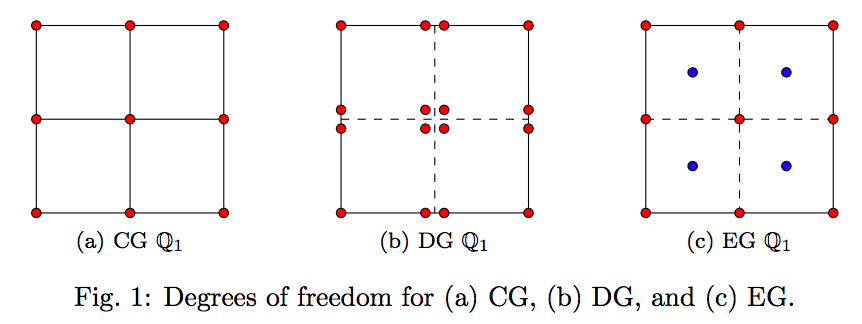
- Local conservation. Element-wise conservative fluxes for coupled flow and transport.
- Reduced complexity. Fewer degrees of freedom than classical discontinuous Galerkin formulations in many settings.
- Heterogeneous coefficients. Robust treatment of material interfaces, fractures, and permeability contrasts.
- Efficient solvers. Block, multilevel, and preconditioned iterative methods tailored to the discrete systems.
Robust and Locking-Free Approximation
For elasticity and poromechanics, robustness requires more than consistency and asymptotic convergence. Discretizations must remain accurate in nearly incompressible regimes and under strong parameter contrasts. This motivated locking-free EG formulations for linear elasticity and poroelasticity, together with parameter-robust solver strategies. Related developments extend EG ideas to the Stokes equations and coupled flow–heat systems.
Bounds, Entropy, and Physical Admissibility
High-order discretizations for transport and nonlinear conservation laws can generate undershoots, overshoots, or entropy-violating states. My recent work combines locally conservative EG discretizations with algebraic flux correction, convex limiting, and property-preserving optimization techniques. The objective is to enforce discrete admissibility without sacrificing consistency or high-order accuracy where the solution is smooth.
- maximum-principle and bound preservation for transport;
- entropy-stable EG methods for nonlinear hyperbolic equations;
- property-preserving limiters for multiphase flow on non-matching meshes.
Multiscale and Heterogeneous Problems
Heterogeneous porous media introduce spatial scales that cannot always be resolved directly. Recent work develops generalized multiscale enriched Galerkin methods that retain local conservation while representing fine-scale permeability effects in reduced coarse spaces. This direction connects structure-preserving discretization with scalable multiscale simulation.
A Posteriori Error Estimation and Adaptivity
Adaptive computation is another component of the program. Current work includes a posteriori error estimation for EG discretizations of parabolic problems and goal-oriented error estimation based on equilibrated stress reconstruction. The longer-term objective is to make computational fidelity depend on the quantity of interest or downstream decision, rather than on solution error alone.
Current Directions
- Goal-oriented computation. Error control targeted to quantities of interest and optimization objectives.
- Structure-preserving multiphysics. Extending conservation and robustness across coupled PDE systems.
- Scalable solvers. Preconditioning and reduced representations for large heterogeneous problems.
- Numerics for learned models. Understanding how discretization error, stability, and physical constraints interact with operator learning and surrogate models.
Selected Publications
- A Goal-Oriented A Posteriori Error Estimator Based on Equilibrated Stress Reconstruction for Linear Elasticity. Submitted.
- An Optimization-Based Property-Preserving Limiter for Two-Phase Flow in Porous Media on Non-Matching Meshes. Submitted.
- Generalized Multiscale Enriched Galerkin Method for Flow in Heterogeneous Porous Media. Mathematical Models and Methods in Applied Sciences, 2026.
- A Posteriori Error Estimation for Parabolic Equations with Enriched Galerkin Finite Element Methods. In revision, Applied Numerical Mathematics, 2026.
- Bound-Preserving and Entropy-Stable Enriched Galerkin Methods for Nonlinear Hyperbolic Equations. Journal of Computational Physics, 541, 114323, 2025. arXiv
- Physics-Preserving Enriched Galerkin Method for a Fully-Coupled Thermo-Poroelasticity Model. Numerische Mathematik, 156, 949–978, 2024.
- Locking-Free and Locally-Conservative Enriched Galerkin Method for Poroelasticity. Journal of Scientific Computing, 94:26, 2023.
- An Enriched Galerkin Method for the Stokes Equations. Computers & Mathematics with Applications, 120, 115–131, 2022.
- Locking-Free Enriched Galerkin Method for Linear Elasticity. SIAM Journal on Numerical Analysis, 60(1), 52–75, 2022.
- A Locally Conservative Enriched Galerkin Approximation and Efficient Solver for the Parabolic Problems. SIAM Journal on Scientific Computing, 38(3), A1404–A1429, 2016.
Related Funded Projects
- NSF DMS-2208402: Physics-Preserving Adaptive Finite Element Methods for Thermo-Poroelasticity.
- DOE Science Foundations for the Energy Earthshots: Advanced Multi-Physics Machine Learning for Subsurface Energy Systems Across Scales.