Scientific Machine Learning
Learning operators, reduced representations, and data-driven models for PDE systems while retaining connections to numerical approximation, physical structure, and reliability.
Overview
My scientific machine learning research is built around a numerical-analysis viewpoint: learned models should complement high-fidelity PDE solvers rather than replace mathematical structure. I study operator learning, finite-element-based neural representations, reduced-order modeling, and physics-guided learning for parameterized and multiphysics systems.
A central question is how approximation, discretization, training, and extrapolation errors interact. This perspective motivates methods that use numerical spaces, reduced bases, or physical constraints directly in the learning architecture and training process.
Operator Learning
Operator-learning methods seek to approximate maps between infinite-dimensional function spaces, such as the solution operator of a parameterized PDE. My work on DeepONet develops a two-step training strategy in which the trunk and branch components are trained sequentially, with orthonormalization used to improve stability and generalization.
- Training strategy. Decompose a difficult joint optimization problem into lower-complexity stages.
- Generalization analysis. Quantify error in terms of training data, network width, and input/output sensor resolution.
- PDE applications. Test operator learning on heterogeneous Darcy flow and related parameterized systems.
- Numerical-space viewpoint. Connect learned operators to discrete approximation spaces and high-fidelity solvers.
Finite-Element Operator Networks
A more recent direction embeds finite element structure directly into operator learning. Discontinuous Galerkin finite element operator networks (DGFEONet) are designed for PDEs with non-smooth solutions, where classical smooth neural representations can be inadequate. This work uses local finite element structure to represent discontinuities while preserving a clear connection between the learned model and the underlying PDE discretization.
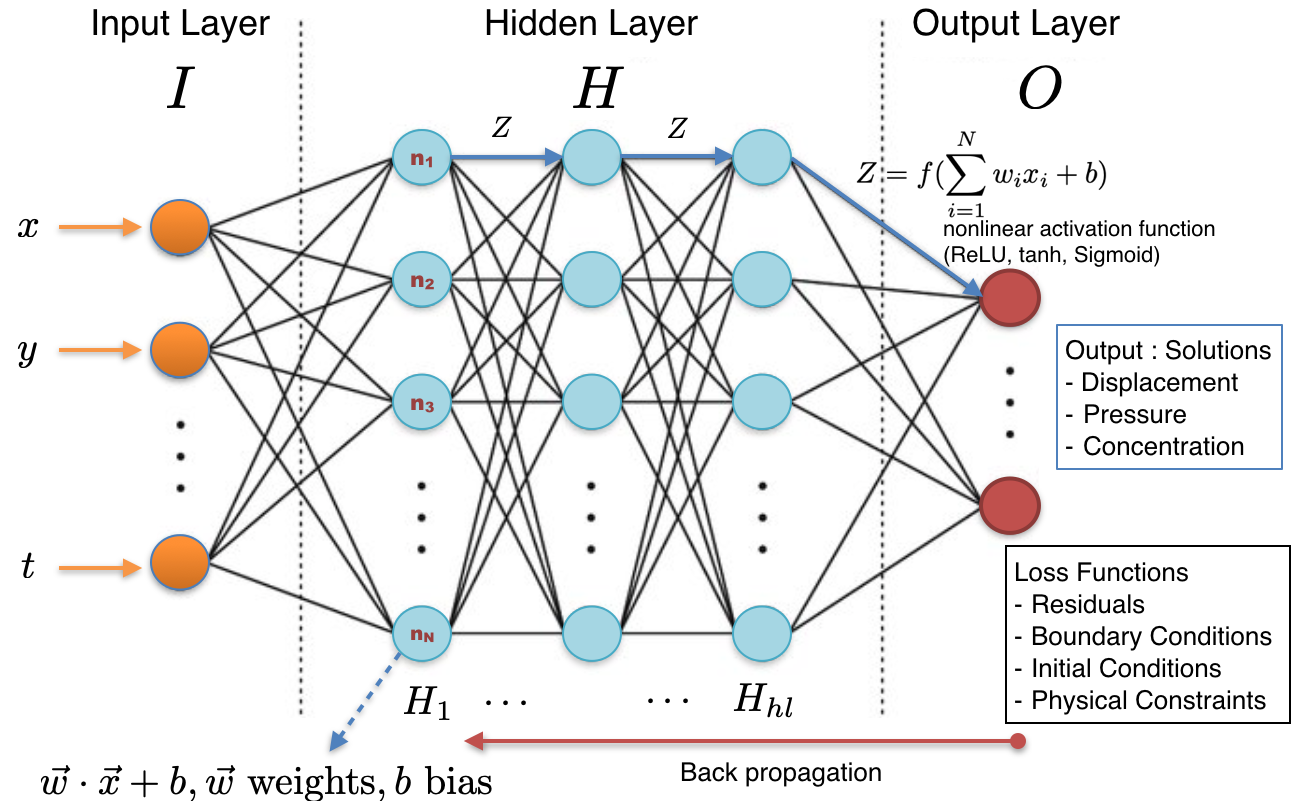
Scientific machine learning and PDE discretization
Reduced and Multi-Fidelity Modeling
Reduced-order modeling provides a complementary route to acceleration. My work includes projection-based reduced models for iterative thermo-poroelasticity solvers and reduced models designed to accelerate high-fidelity nonlinear simulations. Current projects also explore sparse modal representations for coupled thermal-hydraulic-mechanical systems.
- proper orthogonal decomposition and projection-based reduced models;
- reduced representations for sequential multiphysics solvers;
- sparse-mode neural representations for heterogeneous THM systems;
- hybrid high-fidelity / reduced or learned simulation pipelines.
Physics- and Structure-Guided Learning
My earlier work explored physics-informed neural networks for coupled flow and transport and machine-learning-assisted parameter selection in discontinuous Galerkin methods. More recent work develops neural approaches for minimizing energy functionals and for combining learning with finite element forward models in inverse PDE problems.
Across these directions, the common goal is to incorporate variational structure, conservation, discrete spaces, or energy principles into the learned model rather than treating the PDE solver as a black box.
Generalization, Extrapolation, and Verification
Reliability becomes especially important when learned surrogates are used outside the training regime or embedded inside larger simulation and decision workflows. Recent work studies improved extrapolation for thermo-fluid systems by incorporating steady-state information, while the DeepONet analysis provides an explicit theoretical treatment of generalization.
- Generalization. Relate predictive error to training size, representation, and sensor resolution.
- Extrapolation. Use physically meaningful limiting states to improve predictions beyond the training regime.
- Verification. Separate errors due to the high-fidelity discretization from errors introduced by learning.
- Structure preservation. Retain conservation, discontinuities, or variational properties when possible.
Current Directions
- Operator learning for non-smooth PDEs. Finite-element and DG representations for discontinuities and sharp features.
- Multiphysics surrogates. Reduced and learned models for THM/THMC and subsurface systems.
- Reliability and uncertainty. Error decomposition, extrapolation diagnostics, and uncertainty-aware learned models.
- Hybrid numerical-learning methods. Combining classical discretization, reduced models, and machine learning in one computational pipeline.
Selected Publications
- SparseModesNet for Coupled Thermal-Hydraulic-Mechanical Systems in Heterogeneous Porous Media. Submitted.
- Enhancing Neural Network Extrapolation in Thermo-Fluid Systems Using Steady-State Solutions. Submitted. arXiv
- Discontinuous Galerkin Finite Element Operator Network for Solving Non-Smooth PDEs. SIAM Journal on Scientific Computing, 2026. arXiv
- A Machine Learning and Finite Element Framework for Inverse Elliptic PDEs via Dirichlet-to-Neumann Mapping. Journal of Computational and Applied Mathematics, 486, 117679, 2026. arXiv
- On the Training and Generalization of Deep Operator Networks. SIAM Journal on Scientific Computing, 46(4), C273-C296, 2024. arXiv
- A Novel Technique for Minimizing Energy Functional Using Neural Networks. Engineering Applications of Artificial Intelligence, 133, 108313, 2024.
- Projection-Based Reduced Order Modeling of an Iterative Scheme for Linear Thermo-Poroelasticity. Results in Applied Mathematics, 21, 100430, 2024. arXiv
- Enhancing High-Fidelity Nonlinear Solver with Reduced Order Model. Scientific Reports, 12, 2022.
- Physics-Informed Neural Networks for Solving Coupled Flow and Transport System. AAAI Spring Symposium: MLPS, 2021.
- Choice of Interior Penalty Coefficient for Interior Penalty Discontinuous Galerkin Method for Biot's System by Employing Machine Learning. International Journal of Numerical Analysis and Modeling, 21, 764-792, 2024.
Related Funded Projects
- DOE ASCR: From Uncertainty to Trust: A Scalable Stochastic Computing Framework for Uncertainty Reduction in Artificial Intelligence.
- DOE Science Foundations for the Energy Earthshots: Advanced Multi-Physics Machine Learning for Subsurface Energy Systems Across Scales.
- NRF Basic Research Lab: Operator-Composition-Based Theoretical Analysis of Deep Neural Networks: Focusing on the Transformer.